Constant Torque vs Variable Torque Drive Selection: A Technical Guide for Indian Engineers
Learn when to choose constant torque vs variable torque drives for industrial machinery. Technical comparison with ABB ACS series, application examples, and selection tips for Indian engineers.
Constant Torque vs Variable Torque Drive Selection: A Technical Guide for Indian Engineers
Selecting the right variable frequency drive (VFD) for a project isn't just about matching HP ratings. Many engineers in India face the critical decision of constant torque vs variable torque drive selection — a choice that directly impacts equipment reliability, energy consumption, and project cost. Get it wrong, and you risk motor overheating, premature drive failure, or unnecessary capital expenditure.
At Digital Controls, we help plant managers, procurement teams, and consultants make this choice with confidence — backed by ABB’s latest drive families and decades of application expertise.
What Are Constant Torque and Variable Torque Loads?
The torque-speed characteristic of your driven machine determines which drive rating you need.
Constant Torque (Heavy Duty)
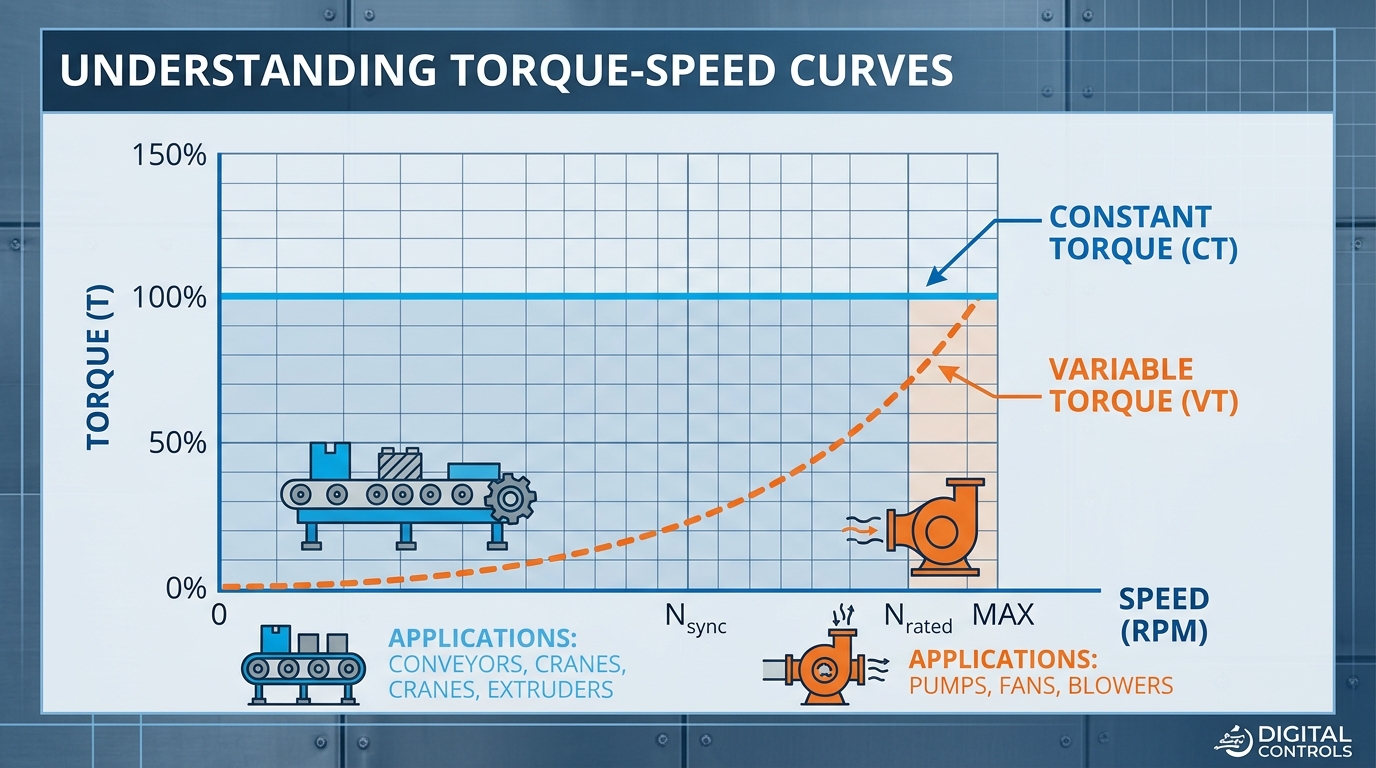
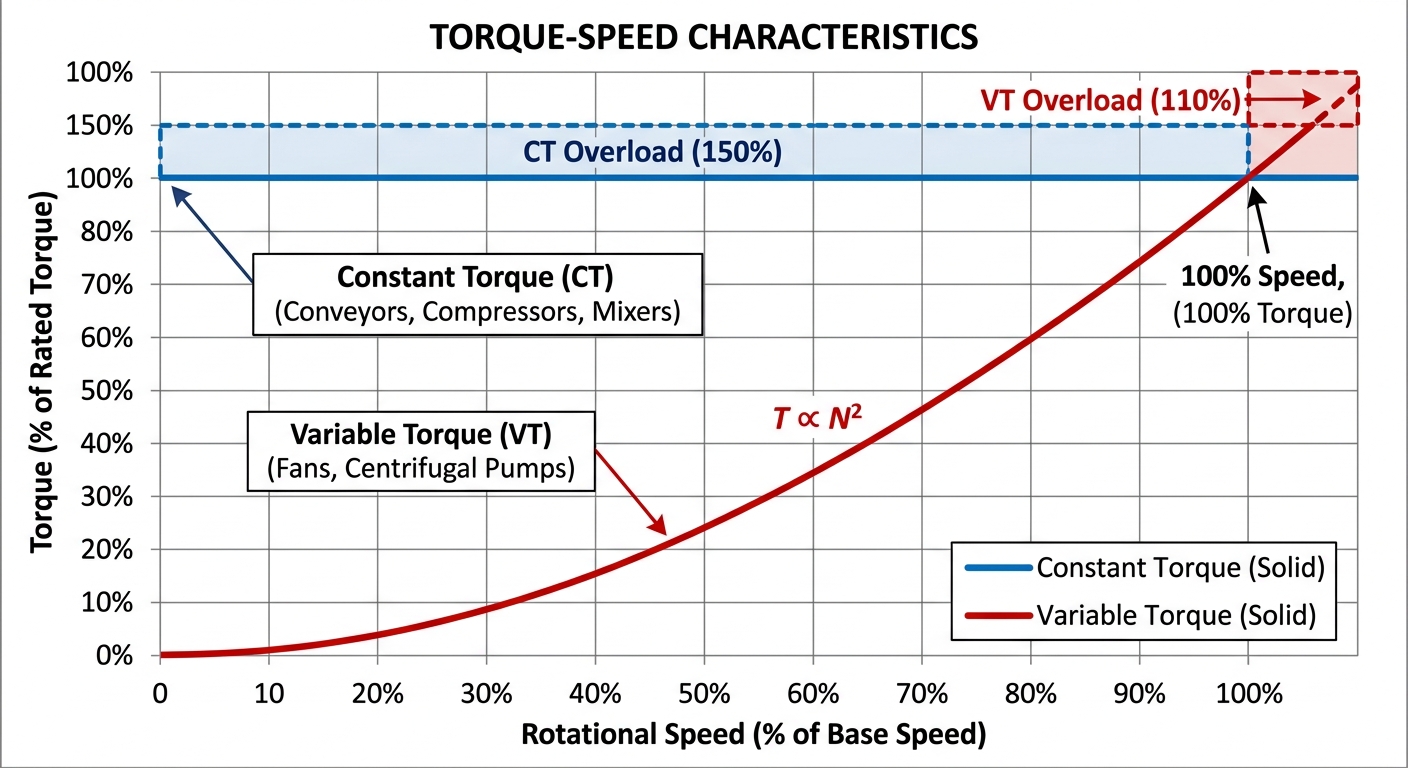
Constant torque loads demand the same torque regardless of speed. The motor must deliver full torque even at low RPM. Examples:
- Conveyors (belt, screw, apron)
- Positive displacement pumps (gear, lobe, piston)
- Compressors (reciprocating)
- Mixers and agitators (high viscosity)
- Hoists and cranes
- Extruders
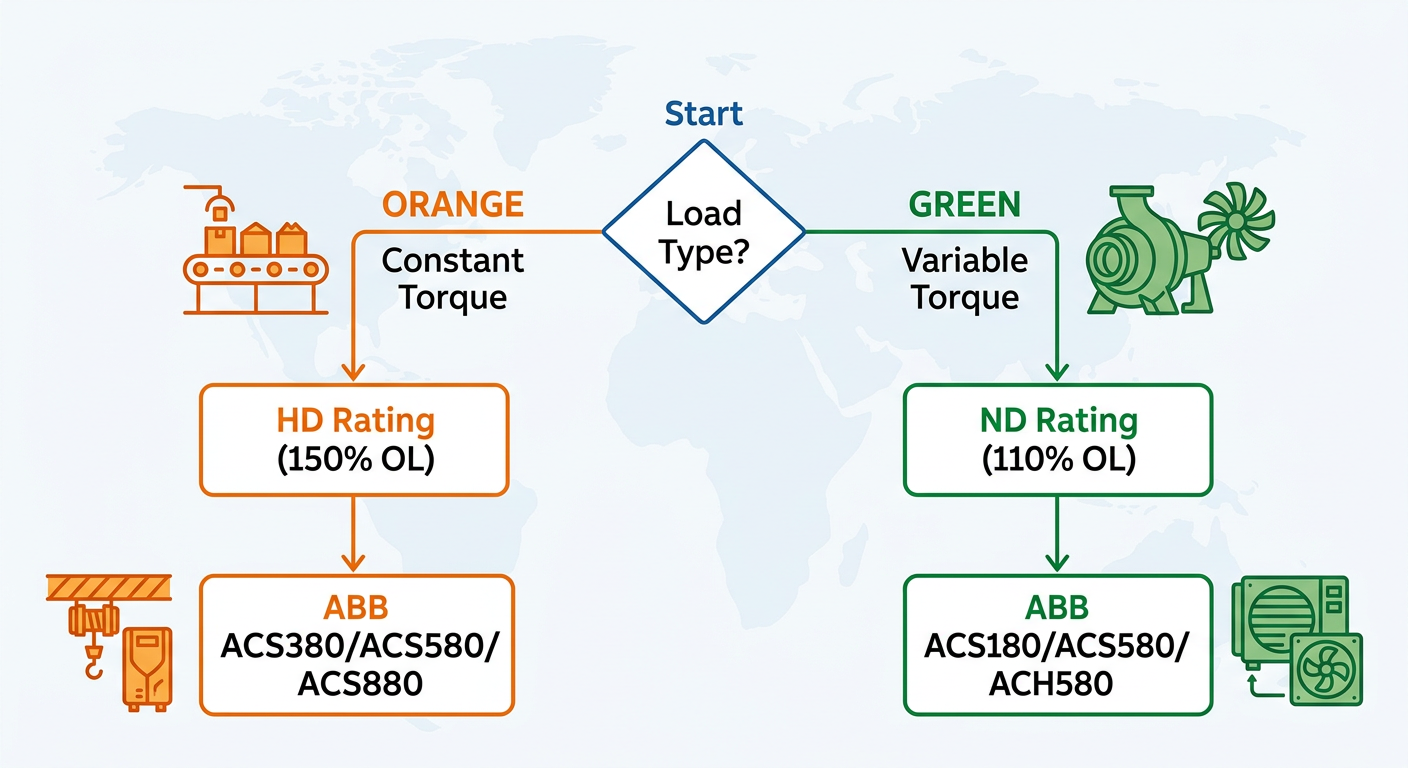
These applications require a VFD rated for constant torque (CT) — often called heavy duty (HD) rating. The drive must handle high starting current and maintain torque output across the speed range.
Variable Torque (Normal Duty)
Variable torque loads follow the fan/pump affinity laws: torque increases with the square of speed, and power increases with the cube. At half speed, torque drops to 25% and power to 12.5%. Examples:
- Centrifugal pumps
- Centrifugal fans and blowers
- HVAC compressors
- Cooling tower fans
For these, a variable torque (VT) or normal duty (ND) rated drive is sufficient. The drive can be sized one or two frames smaller than a constant torque application for the same motor power.
Why the Distinction Matters for Drive Sizing
Modern VFDs like ABB’s ACS180, ACS380, ACS580, and ACS880 series come with dual ratings. The same physical drive unit can be used for both CT and VT applications by selecting the appropriate overload capability.
Overload Capacity
| Duty Type | Overload | Typical Use Case |
|---|---|---|
| Constant Torque (HD) | 150% for 60 seconds | Conveyors, compressors |
| Variable Torque (ND) | 110% for 60 seconds | Fans, centrifugal pumps |
A drive selected for variable torque may fail under a constant torque load if it trips on overload during startup or low-speed operation.
The Sizing Pitfall
Many engineers simply match the motor nameplate kW to the drive output — but this is risky. A 30 kW motor driving a positive displacement pump needs a constant torque VFD rated for 30 kW (HD). The same motor driving a centrifugal fan might only need a drive rated for 25 kW (ND), saving cost.
ABB’s web-based drive and motor selector helps automate this distinction, replacing catalog browsing with guided questionnaires. You input the load type, and the tool recommends the correct frame size.
How ABB’s Unified Drive Family Simplifies Selection
ABB has standardized its low-voltage AC drive portfolio into four core series:
- ACS180 — Compact, cost-effective for basic constant torque and variable torque applications
- ACS380 — Feature-rich for machinery building and industrial applications
- ACS580 — General-purpose for pumps, fans, and conveyors with built-in energy optimizer
- ACS880 — High-performance for critical processes, cranes, and extreme duty
All four share common hardware and software platforms, reducing spare part inventory and training overhead. This all-compatible drive family approach means you can standardize on one product line across your plant — whether for constant torque conveyors or variable torque fans.
Application-Specific Selection Guide
Here is a practical decision framework for constant torque vs variable torque drive selection based on real Indian industrial scenarios.
Scenario 1: Cement Plant Conveyor (Constant Torque)
- Load: 50 kW, belt conveyor starting under full load
- Requirement: High starting torque, sustained overload capability
- Recommended Drive: ABB ACS580 in constant torque mode rated for 50 kW HD
- Key Consideration: Select drive with >150% overload to handle breakaway torque of stuck belts
Scenario 2: Textile Plant Fan (Variable Torque)
- Load: 37 kW, centrifugal exhaust fan
- Requirement: Speed control for airflow modulation
- Recommended Drive: ABB ACS580 in variable torque mode rated for 37 kW ND (or even 30 kW ND based on actual duty)
- Energy Saving: 30–50% compared to damper control
Scenario 3: Water Treatment Positive Displacement Pump (Constant Torque)
- Load: 15 kW, progressive cavity pump handling sludge
- Requirement: Constant torque at low speeds to maintain pressure
- Recommended Drive: ABB ACS380 constant torque rated, with torque boost at startup
- Note: Oversizing by one frame if the pump sees occasional blockages
Scenario 4: HVAC Centrifugal Chiller (Variable Torque)
- Load: 250 kW centrifugal compressor
- Requirement: Smooth speed variation between 30% and 100%
- Recommended Drive: ABB ACS880 ultra-low harmonic drive (ACH580) to meet IEEE 519 harmonic limits
- Efficiency: Combined with SynRM motor for highest IE5 efficiency
Practical Selection Steps
Follow this process when evaluating a new or retrofit drive:
- Determine Load Torque Profile — Is the torque constant or proportional to speed? Check the driven machine’s data sheet or consult the OEM.
- Measure Motor Nameplate — Record voltage, current, power, and service factor.
- Check Starting Conditions — Does the machine require high breakaway torque (e.g., scrapers, mixers)?
- Select Duty Rating — Use ABB’s drive selector tool or refer to the rating charts in your ABB catalog.
- Account for Environmental Factors — Ambient temperature, altitude, and enclosure type affect drive de-rating.
- Harmonic Mitigation — For variable torque drives on large fans/pumps, consider built-in harmonic filters (ACH580) to reduce THDi below 5%.
- Control Panel Integration — Coordinate with your panel builder for proper cable sizing, fuses, and cooling.
Digital Controls provides application review and control panel coordination for every drive project — ensuring the selected drive integrates seamlessly with your existing MCC and PLC systems.
Energy Efficiency: The Hidden Benefit of Correct Selection
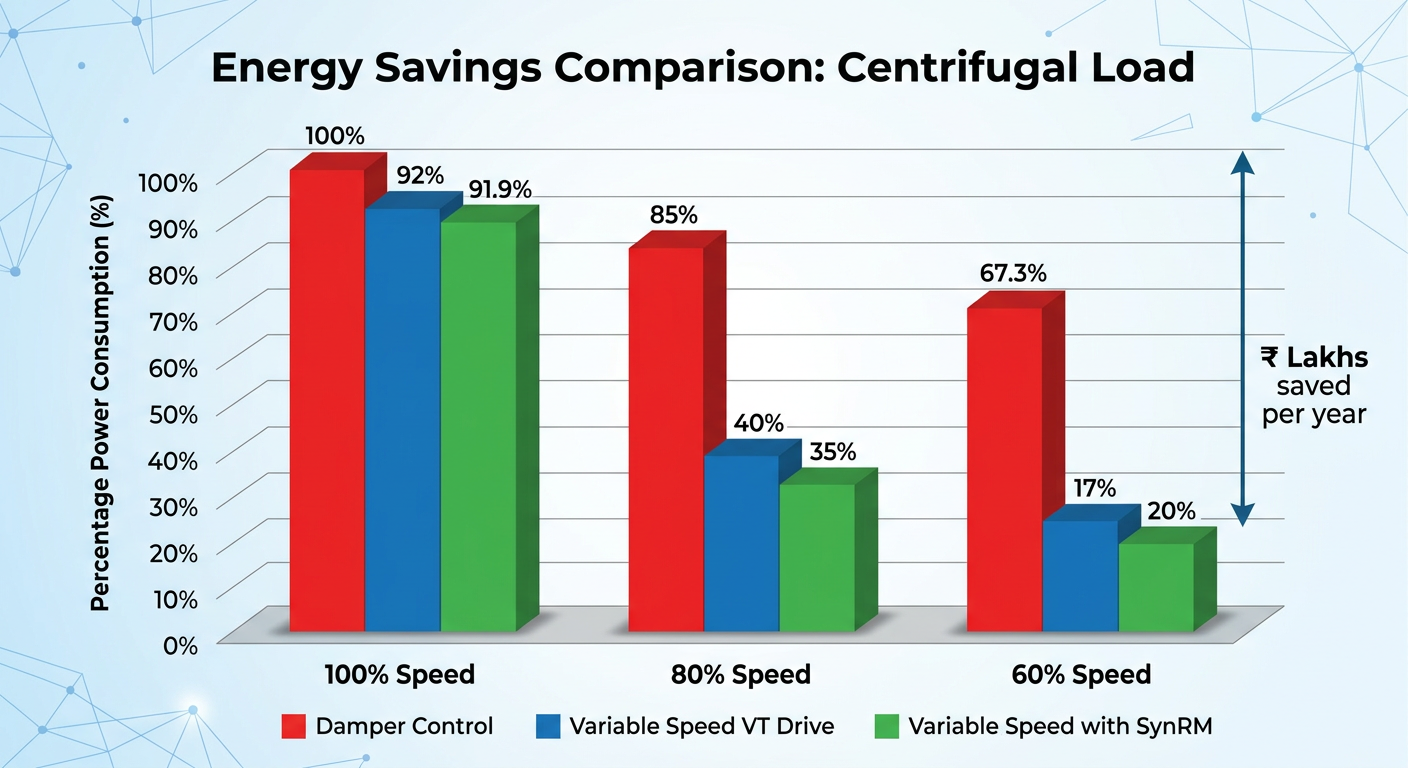
Properly selecting between constant torque and variable torque drives unlocks significant energy savings. For variable torque loads, each 10% reduction in speed yields roughly 27% power savings. Over a year, a 100 kW fan running at 80% speed can save ₹6–8 lakhs in electricity costs.
ABB’s EnergySave package combines the ACS580/ACS880 drive with a SynRM (synchronous reluctance) motor to achieve IE5 ultra-premium efficiency. For constant torque applications like conveyors, energy savings come from eliminating mechanical throttling and reducing idling losses.
Local technical support from Digital Controls ensures your drive is tuned for optimum efficiency. We offer on-site commissioning support, waveform analysis using Fluke power quality analyzers, and periodic efficiency audits.
Frequently Asked Questions
What happens if I use a variable torque drive for a constant torque application?
The drive will likely trip on overcurrent during startup or low-speed operation because its overload capability (typically 110%) is insufficient. Continuous operation may damage the output transistors due to excessive heating. Always verify the duty rating.
Can the same ABB drive be used for both constant and variable torque?
Yes. ABB drives like the ACS580 and ACS880 can be configured for either constant torque (heavy duty) or variable torque (normal duty) by parameter setting. The only difference is the overload limit and applicable current rating. However, the physical drive size may need to be larger for constant torque to handle higher current.
How do I know if my load is constant torque or variable torque?
Refer to the driven machine’s data sheet. For pumps and fans, variable torque is standard. For conveyors, positive displacement machines, and extruders, assume constant torque. If unsure, measure motor current at different speeds — constant torque shows nearly flat current vs. speed; variable torque shows current dropping roughly as speed decreases.
Should I oversize the drive for safety?
Oversizing by one frame is common for constant torque applications with harsh starting conditions or unknown load variations. For variable torque, oversizing is rarely needed unless there is high ambient temperature or long cable runs. Oversizing increases cost and may reduce efficiency at light loads.
Conclusion
Constant torque vs variable torque drive selection is a fundamental engineering decision that affects equipment longevity, energy costs, and project budget. With ABB’s unified ACS180–ACS880 family, you have the flexibility to choose the right rating for each application while standardizing on a single platform.
At Digital Controls, we don’t just sell drives — we provide application engineering, control panel integration, and commissioning support tailored to Indian industrial conditions. Whether you need a constant torque drive for a cement conveyor or a variable torque drive for a textile fan, our team ensures the selection is correct the first time.
Ready to discuss your next drive project? Contact our application engineers for a free drive selection consultation.
Explore our complete range of ABB AC Drives including the ACS580 and ACS880. Learn more about Variable Frequency Drives and Three Phase Induction Motors.