Energy Efficiency Drive Retrofit ROI: Calculate Payback for Indian Plants
Learn how to calculate payback periods for upgrading to energy-efficient ABB drives in Indian manufacturing. Reduce costs, improve ROI with our practical guide.
Energy Efficiency Drive Retrofit ROI: Calculate Payback for Indian Plants
Indian manufacturers face rising electricity tariffs and margin pressure. One of the fastest ways to cut operational costs is upgrading legacy motor control systems to modern variable frequency drives (VFDs). But the critical question always comes down to energy efficiency drive retrofit ROI: how long before the investment pays for itself?
This article provides a practical framework to calculate payback periods for drive retrofits in Indian manufacturing plants. Whether you are evaluating a 50 HP pump in a textile mill or a 200 HP fan in a cement plant, you will learn the variables that matter and the typical returns you can expect. By the end, you will be equipped to request a quote with confidence.
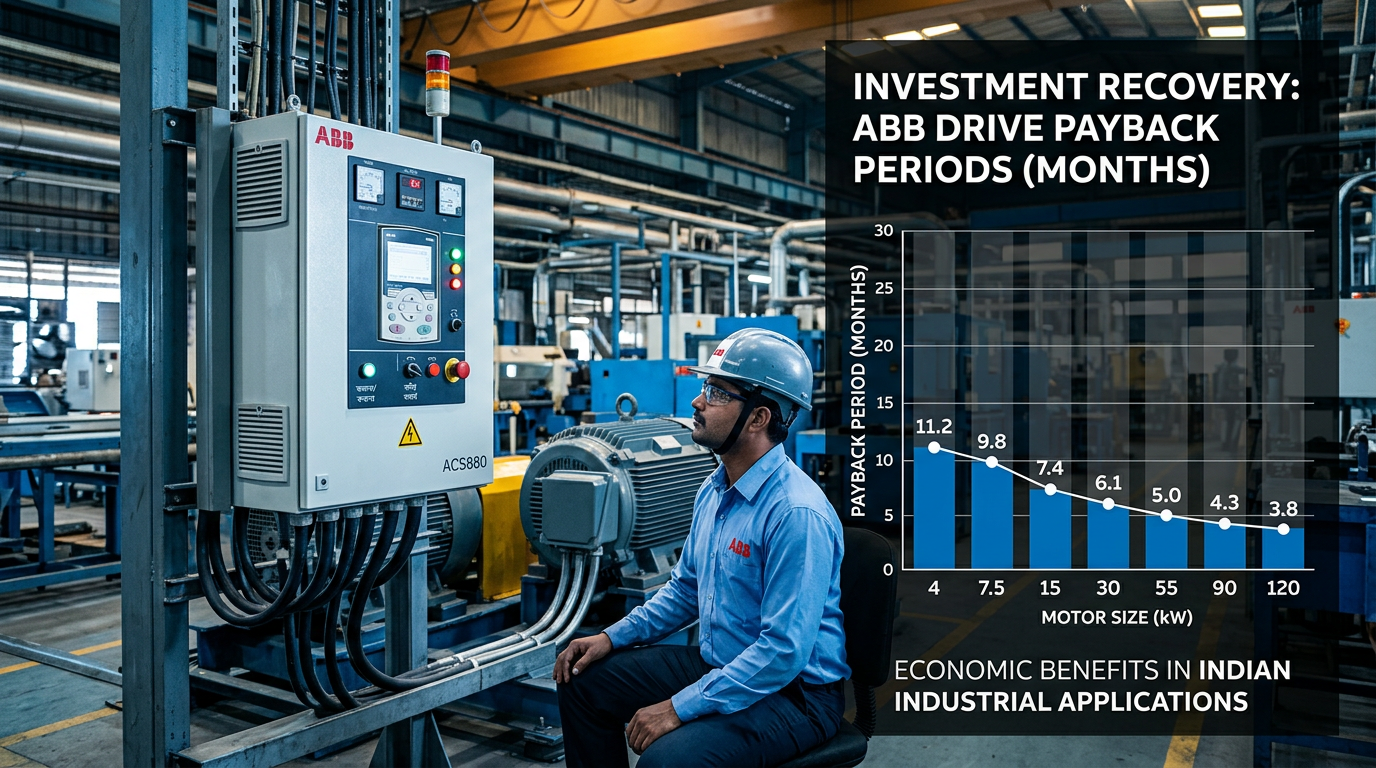
– Cover image: Industrial automation aesthetic, blue and steel tones, showing a panel with ABB drives and a chart overlay of payback periods for Indian plants.
Why Drive Retrofits Matter for Indian Manufacturing
Electric motors consume 40-60% of industrial electricity in India. Most plants still run old fixed-speed motors with mechanical throttling methods like valves, dampers, or vanes. These methods waste energy because the motor runs at full speed regardless of actual demand.
The Energy Saving Potential
Replacing a fixed-speed starter with a VFD allows the motor to match speed exactly to load. For centrifugal pumps and fans, the affinity laws show that power consumption drops with the cube of speed reduction. A 20% speed reduction can cut energy use by nearly 50%. In practice, retrofitting drives on variable-torque applications typically saves 25-40% of electricity.
Beyond Energy: Other Benefits
Energy savings are the headline, but drive retrofits also reduce mechanical stress, lower maintenance costs, and improve process control. Soft starting eliminates inrush current spikes, extending motor and belt life. Power factor correction reduces kVA demand charges. These indirect savings further improve the overall ROI of an energy efficiency drive retrofit.
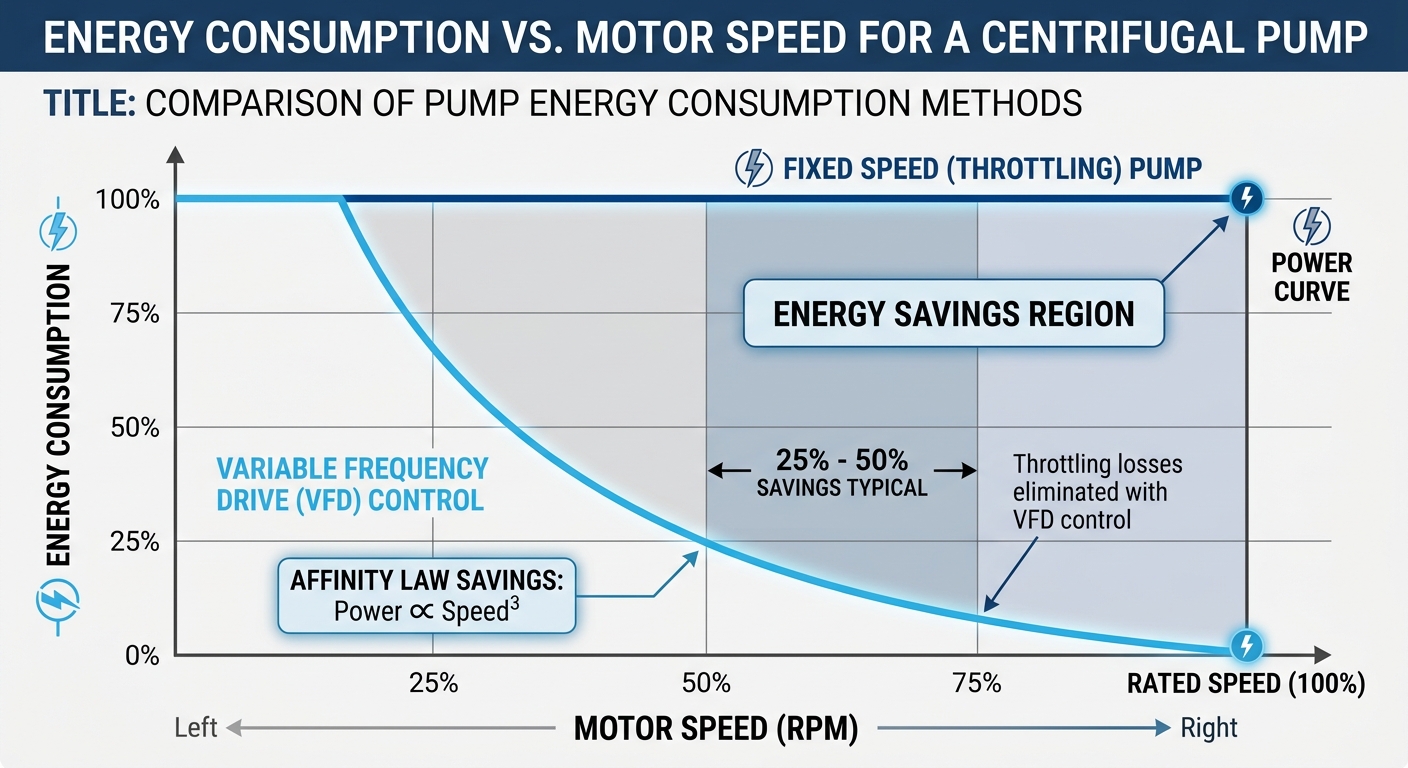 – Diagram showing energy consumption vs speed for a pump: fixed speed vs VFD, with annotated savings regions.
Calculating the ROI of an Energy Efficiency Drive Retrofit
To calculate payback period, you need four key inputs:
- Motor power rating (HP or kW)
- Average operating hours per year (e.g., 6000 hours for continuous process)
- Current electricity tariff (₹ per kWh – typical Indian industrial tariff ₹6-10/kWh)
- Estimated energy savings percentage (based on application type and speed profile)
Formula for Payback Period
Payback (years) = Total retrofit cost / Annual energy cost savings
Where:
- Total retrofit cost = drive price + installation + panel modifications + commissioning
- Annual energy cost savings = (Motor kW × Load factor × Annual hours × Tariff) × Savings %
Key Variables Explained
- Load factor: For variable-torque loads (fans, pumps) at 80% average speed, the power reduction is ~50%. For constant-torque loads (conveyors, compressors), savings are lower, typically 15-25%.
- Annual hours: Higher runtime shortens payback. A 24×7 plant will see much faster ROI than a single-shift operation.
- Tariff escalation: Indian tariffs rise 3-5% annually. Including escalation in your model gives a more accurate picture.
Example Calculation for a 50 HP Pump
Assumptions:
- Motor: 50 HP (37 kW), centrifugal pump, average speed 80%
- Annual operation: 8000 hours (continuous)
- Current tariff: ₹8/kWh
- Retrofit cost: ABB ACS580 drive (₹1,80,000) + installation and panel (₹70,000) = ₹2,50,000
- Estimated energy savings: 40%
Calculation:
- Baseline consumption: 37 kW × 8000 h = 2,96,000 kWh/yr
- Baseline cost: 2,96,000 × ₹8 = ₹23,68,000/yr
- Savings: 40% × ₹23,68,000 = ₹9,47,200/yr
- Payback: ₹2,50,000 / ₹9,47,200 = 0.26 years (about 3 months)
Even with conservative savings (30%), payback is under 6 months. This is typical for high-utilization pumps in Indian manufacturing.
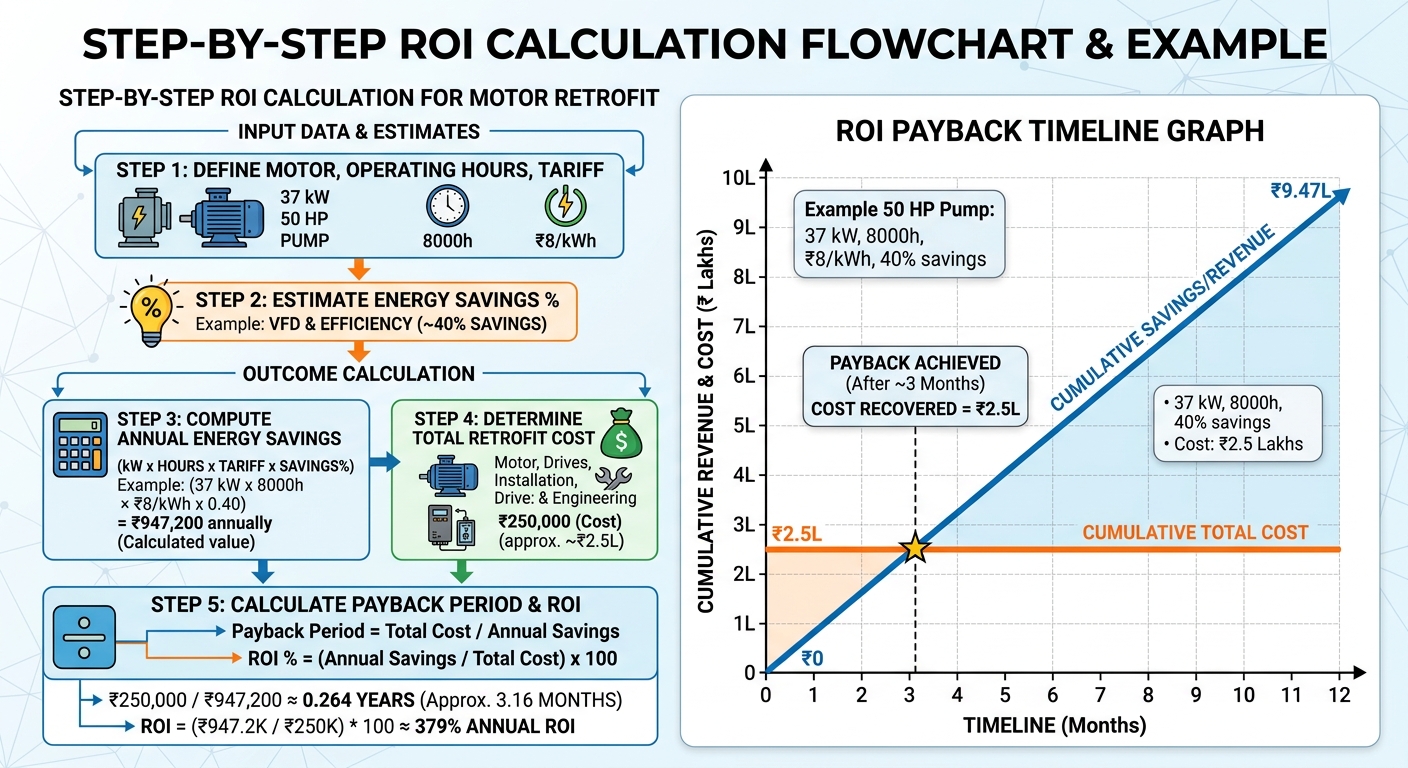 – Flowchart showing step-by-step ROI calculation with example numbers and a payback timeline.
Real-World Payback Periods: Indian Case Studies
Textile Mill Fan Retrofit
A textile mill in Surat replaced fixed-speed fans on 12 ring-frame machines with ABB ACS580 drives. Each fan motor was 30 HP, running 7200 hours/year at 75% average speed. Total project cost: ₹18 lakhs. Annual energy savings: ₹14.5 lakhs. Payback: 15 months.
HVAC Pump Upgrade in a Pharmaceutical Plant
A pharma plant in Hyderabad upgraded three 75 HP chilled water pumps with ABB ACS880 drives. The drives also enabled sequential pump control. Investment: ₹6.5 lakhs. Annual savings: ₹5.2 lakhs. Payback: 15 months. Additional benefit: reduced harmonic distortion with built-in filters.
Conveyor System in a Cement Plant
A constant-torque application – payback is longer. Cement plant in Rajasthan retrofitted 20 conveyors (15-25 HP each) with ABB ACS380 drives. Savings: 18% on energy. Project cost: ₹24 lakhs. Annual savings: ₹7.8 lakhs. Payback: 37 months. Still worthwhile due to reduced mechanical breakdowns.
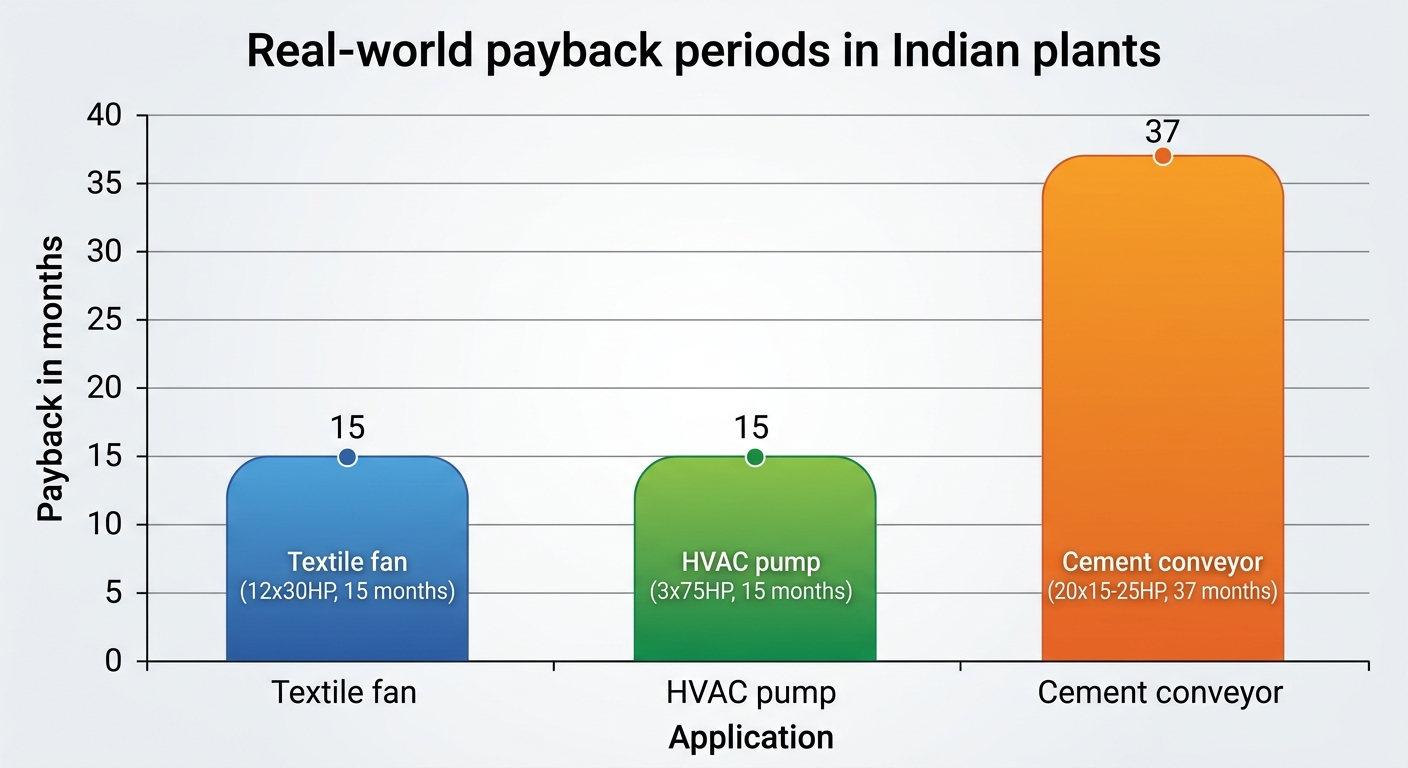 – Bar chart comparing payback periods across three case studies: textile fan, HVAC pump, cement conveyor.
Choosing the Right Drive for Maximum ROI
Selecting the correct drive is crucial to achieving the calculated savings. ABB’s drive family – ACS180, ACS380, ACS580, and ACS880 – covers virtually all applications. Each series balances features and cost.
ABB ACS580 vs ACS880
- ACS580: Ideal for most pump, fan, and conveyor applications. Built-in energy optimizer, easy commissioning, and competitive price. Best for energy efficiency drive retrofit ROI in standard applications.
- ACS880: For demanding environments (high overload, precise speed/position control, regenerative braking). Higher upfront cost but justified when process reliability is critical.
Importance of Proper Sizing (Constant vs Variable Torque)
A common mistake is matching drive power rating exactly to motor rating. For variable-torque loads (pumps, fans), the drive can be downsized because the motor rarely runs at full load. For constant-torque loads (conveyors, extruders), you need the full rating. ABB’s drive selection tools (web-based) now guide engineers through these choices – no more manual datasheet digging. Use the ABB Drive Selector to input your application and get a recommendation instantly.
Using ABB EnergySave Packages
ABB’s EnergySave packages combine SynRM motors (synchronous reluctance) with matching drives. These achieve IE5 efficiency levels and can push additional savings of 5-10% over standard IE3 motors. For new installations or motor replacements, this combination accelerates payback further.
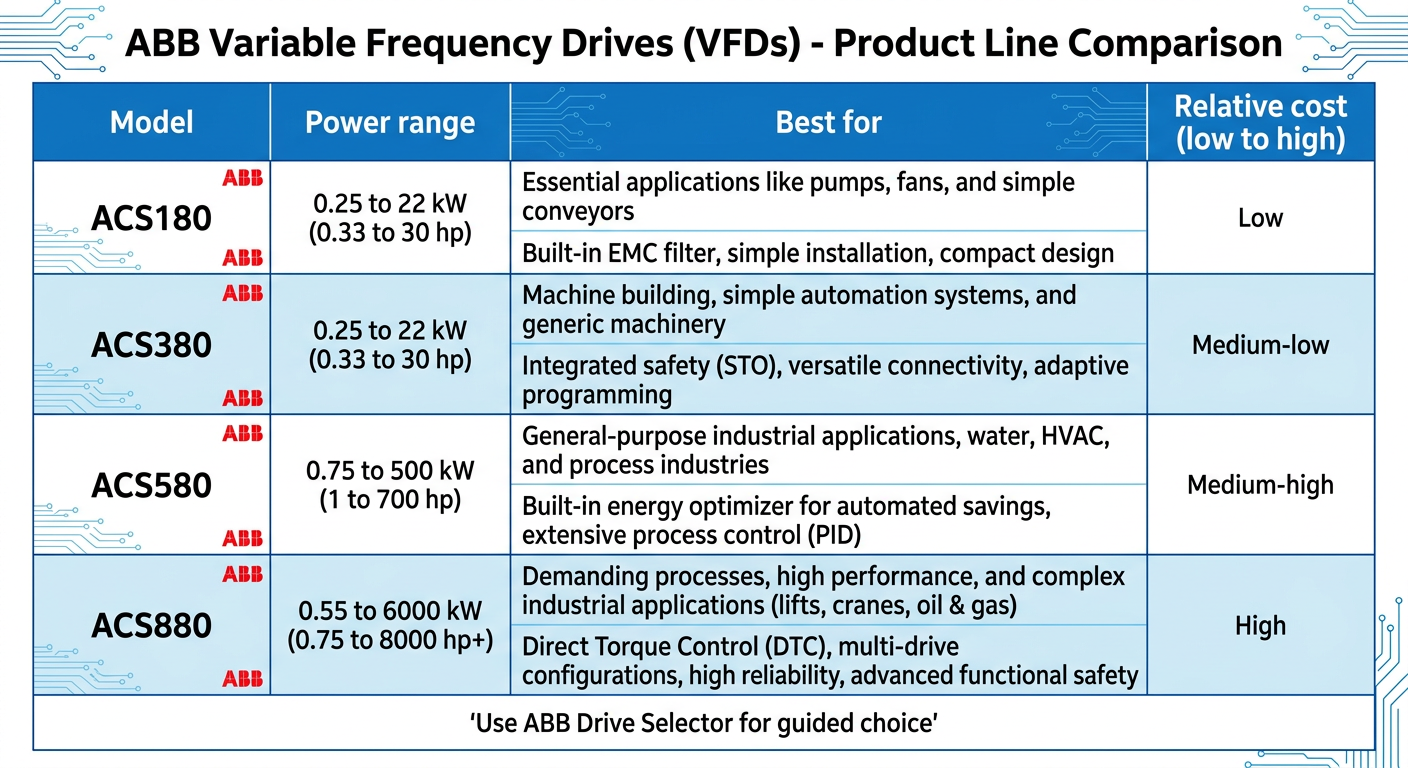 – Comparison chart: ACS180, ACS380, ACS580, ACS880 with key specs, price range, and best application.
Installation and Commissioning for Best Results
Energy savings don’t happen automatically. Proper installation and commissioning are vital. A poorly tuned drive can waste the potential savings.
Working with a Local Partner
Indian plants benefit from working with suppliers who provide application review, control panel coordination, and on-site commissioning. At Digital Controls, we review your motor load profile, recommend the correct drive, and ensure seamless integration with existing panels. We also offer commissioning services to validate performance.
Using Fluke Test Instruments for Verification
After installation, use Fluke power quality analyzers and thermal imagers to verify savings. Measure actual kW before and after the retrofit. Check for harmonics, voltage imbalance, and motor temperature. This data not only confirms ROI but also helps fine-tune drive parameters for maximum efficiency.
Frequently Asked Questions
What is the typical payback period for an energy efficiency drive retrofit?
For variable-torque applications (pumps, fans) running 6000+ hours/year, payback is usually 6-18 months. Constant-torque applications (conveyors, compressors) may take 2-3 years. High-utilization continuous processes often see payback under a year.
How much energy can I save by adding a VFD to my motor?
Savings depend on the application. For centrifugal pumps and fans, 25-50% is common. For conveyors and compressors, 10-20%. The key is the speed profile – the more variable the load, the greater the savings.
What factors affect the ROI of a drive retrofit?
Operating hours, electricity tariff, motor size, application type, and the cost of the drive and installation. Including tariff escalation (3-5% per year) in your model shows a faster actual payback.
Is it worth upgrading older motors along with the drive?
If your motor is IE1 or IE2, replacing it with an IE3 motor plus a drive can improve overall system efficiency by another 5-10%. For IE2 motors with many years of remaining life, a drive-only retrofit often provides the best ROI. Our team can evaluate your motor condition and recommend the optimal combination.
Conclusion: Your Next Step to Lower Energy Costs
Calculating the energy efficiency drive retrofit ROI is straightforward when you have the right data. Indian manufacturing plants that upgrade old motor controls to modern ABB VFDs typically recover their investment within 12-18 months and continue saving for years. With digital selection tools, standardized drive families, and local technical support, the process has never been easier.
Are you ready to cut your energy bill? Contact Digital Controls today for a free payback assessment and a detailed quote. We’ll help you choose the right drive, install it, and commission it for maximum savings.
Enquire Now – Let’s calculate your ROI together.