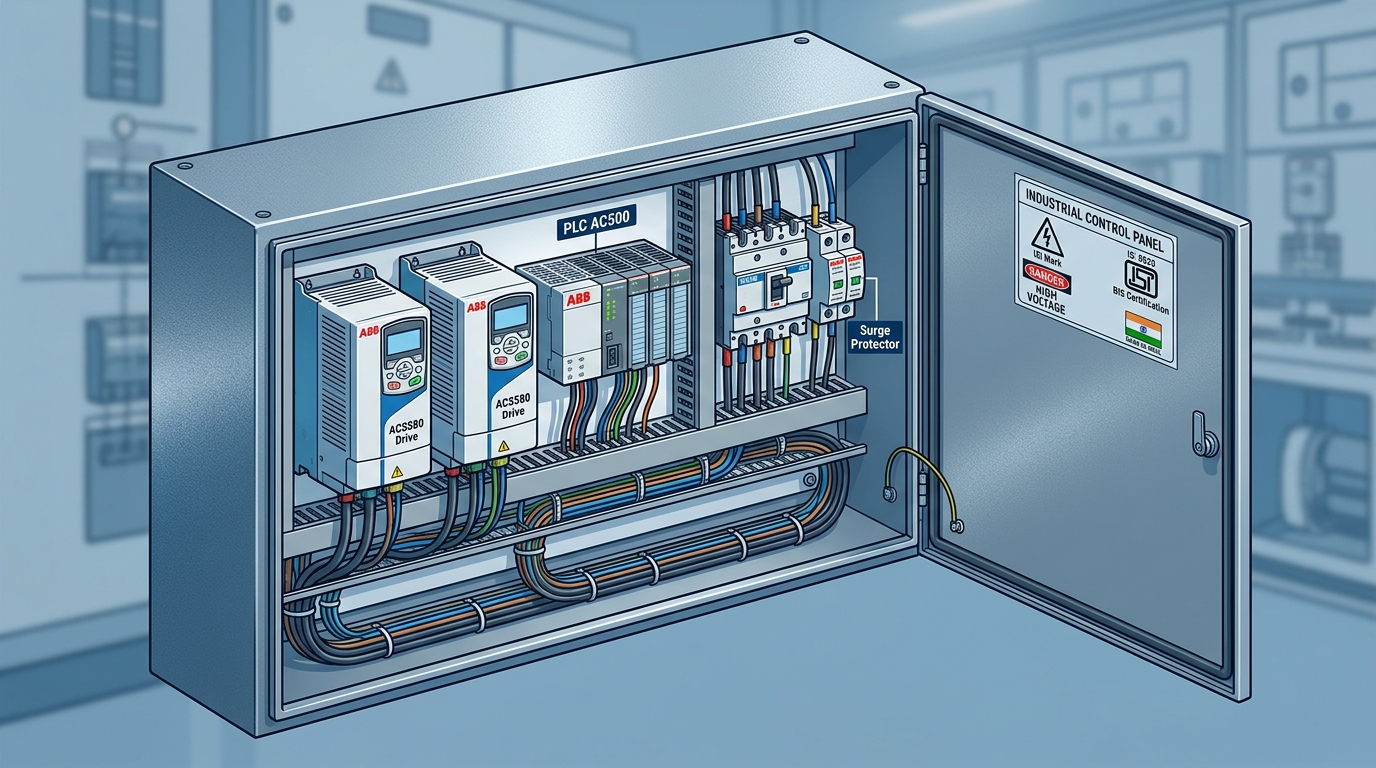
Industrial Control Panel Design Best Practices with ABB Drives & PLCs
Learn industrial control panel design best practices for Indian panel builders and OEMs. Covers ABB drives, PLCs, protection devices, VFD selection, and commissioning support. Optimize your panel assembly with expert guidance.
When you're building a control panel for a production line in Pune or a sewage pump station in Chennai, every component choice and wiring decision matters. Industrial control panel design is the foundation of reliable automation, and getting it right means fewer field failures, faster commissioning, and lower lifecycle costs.
For Indian engineers and procurement teams, the challenge is balancing cost with performance while sourcing components that are readily available and technically backed. ABB drives, PLCs, and protection devices have become the default choice for many panel builders, thanks to their robust ecosystem and local support. But even the best components need thoughtful integration.
This guide covers the critical best practices for industrial control panel design — from selecting VFDs and PLCs to thermal management, wiring segregation, and commissioning with Fluke instruments. Whether you're an OEM assembling standard panels or a plant manager overseeing a retrofit, these insights will help you deliver panels that perform consistently under Indian conditions.
Key Components of Industrial Control Panel Design
A well-designed control panel starts with component selection. For motor control applications, the three pillars are variable frequency drives (VFDs), programmable logic controllers (PLCs), and protection devices. Here’s what to focus on.
VFD Selection: ABB ACS Drives Family
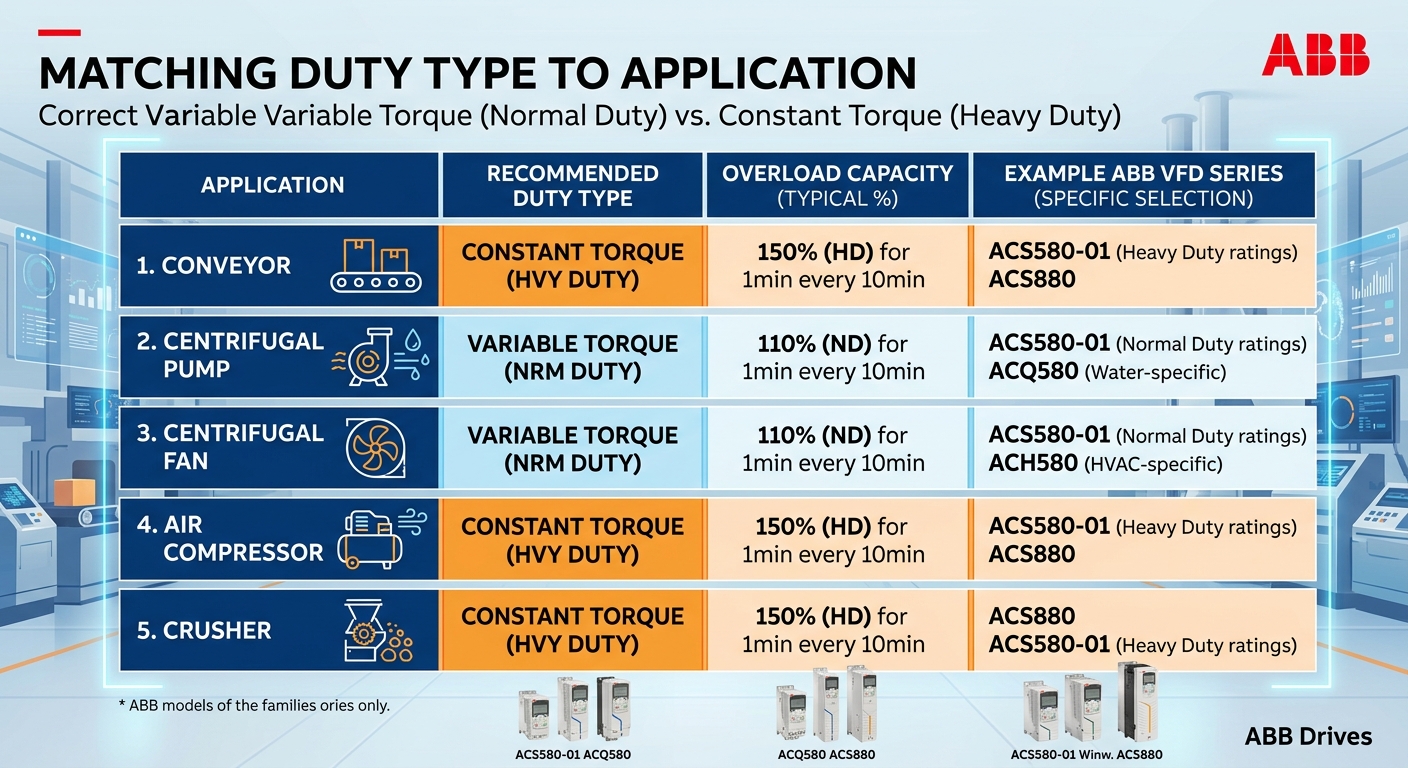
ABB’s unified ACS180, ACS380, ACS580, and ACS880 series simplify selection across applications. The key differentiator is whether you need constant torque (heavy duty) or variable torque (normal duty) sizing. For example, a crusher conveyor requires constant torque throughout its speed range, while a centrifugal pump sees torque vary with speed.
- ACS180: Compact, cost-effective for basic applications like fans and small pumps.
- ACS380: Best for machinery requiring built-in safety functions and fieldbus connectivity.
- ACS580: All-rounder for water, HVAC, and material handling — includes energy optimizer.
- ACS880: Top-tier for demanding processes like cranes, hoists, and extruders.
Use ABB’s web-based drive selector to input motor parameters and application type. It returns the optimal drive variant and accessory list — no more manual datasheet comparisons.
Tip for panel builders: Standardize on a single drive family across your designs. This reduces spare parts inventory and training costs for your commissioning team.
Learn more about ABB drives and their wide range at digitalcontrols.org/abb.
PLC Selection: ABB AC500 and AC800M
Your PLC must handle the I/O count, communication protocols (Modbus, Profibus, EtherNet/IP), and speed required by the process. For panel applications, the ABB AC500 series is popular because of its modularity and built-in web server for remote diagnostics.
When integrating VFDs, ensure the PLC can send speed references and read actual torque/current via fieldbus. This eliminates hardwired analog signals and reduces wiring errors.
Protection and Switchgear
Every panel needs circuit breakers, contactors, overload relays, and surge protection. ABB’s SACE breakers and AF contactors are widely used in Indian installations. Pay attention to:
- Short-circuit current rating (SCCR): Must match the source fault level. Many Indian sites have higher fault currents than EU designs anticipate.
- Coordination: Type 2 coordination between contactor and overload relay prevents welding during a fault.
- Surge protection: In regions with frequent thunderstorms (e.g., Kerala, Maharashtra), a surge arrester on the AC supply is non-negotiable.
Browse our range of low voltage switchgear at digitalcontrols.org/products/lv-switchgear.
Best Practices for Panel Layout and Wiring
A cluttered panel runs hot. A poorly wired panel is a nightmare to troubleshoot. Follow these layout and wiring standards for reliable operation.
Thermal Management
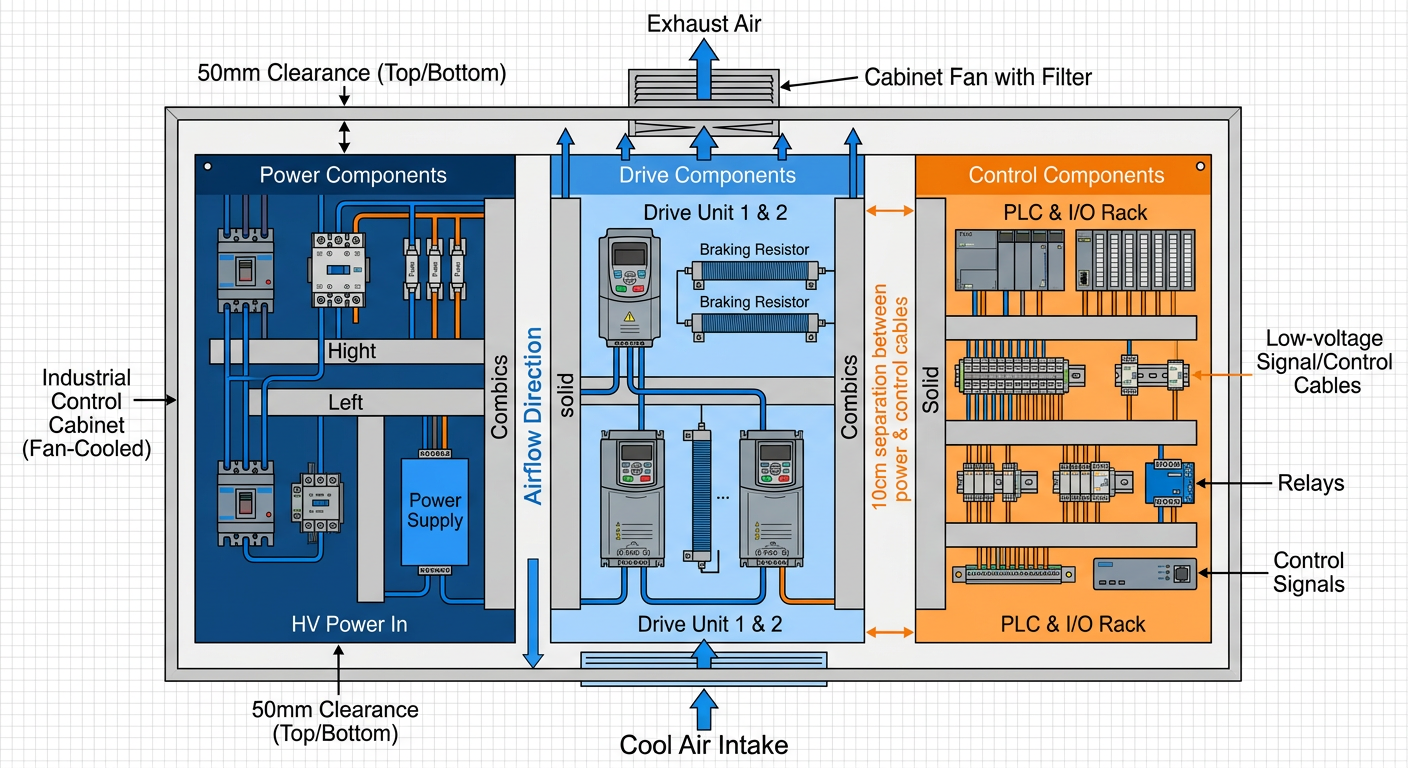
Control panels in Indian factories often sit in ambient temperatures of 40°C or more. Add heat from VFDs and PLCs, and internal temperature can exceed 55°C — reducing component life.
- Calculate total heat dissipation of all components. VFDs can dissipate 3–5% of their rated power as heat.
- Use CFD (computational fluid dynamics) software to simulate airflow. Don’t rely on gut feel.
- Mount drives with adequate clearance (top and bottom) for natural convection.
- For panels above 35°C ambient, install a fan or heat exchanger with filter. Choose IP54-rated filters to avoid dust ingress.
Wiring Segregation
Separate power cables from control cables to prevent electromagnetic interference (EMI). VFDs generate high-frequency noise that can corrupt PLC analog inputs or encoder signals.
- Use screened cables for analog signals and fieldbus.
- Ground screens at one end only (usually at the PLC side).
- Keep at least 10 cm between power and control cables inside the panel.
- Use separate cable trays or barriers.
Labeling and Documentation
Every wire, terminal, and component should have a unique reference that matches the electrical schematic. This is especially important when panels are built by one team and commissioned by another — common in Indian EPC projects.
- Use heat-shrink labels with permanent markers.
- Provide a printed wiring diagram inside the panel door.
- For complex panels, include a QR code linking to the digital cabinet layout.
Integrating ABB Drives and PLCs for Optimal Performance
The real value of industrial control panel design comes from how well the VFD and PLC communicate. Poor integration leads to missed alarms, inefficient energy usage, and nuisance trips.
Using ABB’s DriveAPI and Web Server
Modern ABB drives (ACS580/880) include an embedded web server. Connect the drive to your plant network and monitor parameters via a standard browser — no additional software needed. This is a huge time-saver during commissioning.
For deeper integration, use ABB’s DriveAPI (RESTful API) to pull real-time data into your SCADA or PLC. This enables predictive maintenance by tracking motor current, temperature, and run hours.
Application-Specific Programming
Don’t rely solely on default drive parameters. Configure:
- Acceleration/deceleration ramps based on load inertia. Too fast causes overcurrent trips; too slow wastes production time.
- Skip frequencies to avoid mechanical resonance in fans or pumps.
- Flying start for restarting spinning motors (e.g., in pumping stations).
Drive Selection for Constant vs. Variable Torque
A common mistake is selecting a VFD based solely on motor rated power. A 15 kW motor driving a positive displacement pump (constant torque) may require a drive rated for 18.5 kW heavy duty, while the same motor driving a centrifugal pump (variable torque) could run on a 15 kW normal duty drive.
ABB’s ACS580 datasheet clearly shows heavy duty (HD) and normal duty (ND) ratings. Always check the HD rating for applications like conveyors, compressors, and extruders.
Explore our full range of AC drives at digitalcontrols.org/products/ac-drives.
Protection and Safety Devices in Control Panels
Beyond circuit breakers, modern control panels must incorporate safety functions to protect personnel and equipment. ABB’s drives come with built-in safety features that can replace external safety relays.
Safe Torque Off (STO)
All ABB ACS drives include STO as standard. This allows you to safely remove motor torque without disconnecting the main power — ideal for maintenance operations. Connect your emergency stop circuit directly to the STO inputs.
Integrated Arc Fault Protection
For panel builders, ABB offers arc fault detection devices (AFDDs) that sense the light and current signature of an arc within the panel and trip the upstream breaker instantly. This is increasingly required by Indian electrical inspectorates for high-power panels.
Surge Protection Devices
We recommend installing type 2 surge arresters at the main incoming terminals of the panel. For drives, add a type 1+2 device if the panel is near the main distribution board. This prevents lightning-induced transients from destroying semiconductor devices.
Commissioning and Troubleshooting with Fluke Instruments
Once the panel is wired and powered, commissioning begins. This is where Fluke test instruments prove invaluable — from verifying continuity to capturing intermittent faults.
Fluke 1587 FC Insulation Multimeter
Before applying power, check motor and cable insulation resistance. A low reading indicates moisture or damaged insulation — catch it before you wreck the drive. The Fluke 1587 FC also performs polarization index tests for large motors.
Fluke Ti450 Thermal Imager
Twenty minutes after panel start-up, scan all components with a thermal camera. Loose connections, overloaded breakers, and failing capacitors show up as hot spots. Document baseline thermal images for future comparison.
Fluke 438-II Power Quality Analyzer
For drives that cause nuisance tripping, use a power quality analyzer to measure harmonics, voltage sags, and current unbalance. ABB’s ACS880 can handle high harmonics, but poor grid quality still affects performance.
Field note: One panel builder in Gujarat found that a loose neutral connection was causing every VFD to trip on overvoltage. A Fluke 43B identified the imbalance in minutes — saved a whole day of troubleshooting.
Find the right Fluke instruments for your panel commissioning at digitalcontrols.org/products/fluke.
Energy Efficiency and Future-Proofing
Indian manufacturers are under increasing pressure to reduce energy costs. Your industrial control panel design can directly contribute to energy savings through proper component selection and system architecture.
SynRM Motors with ABB Drives
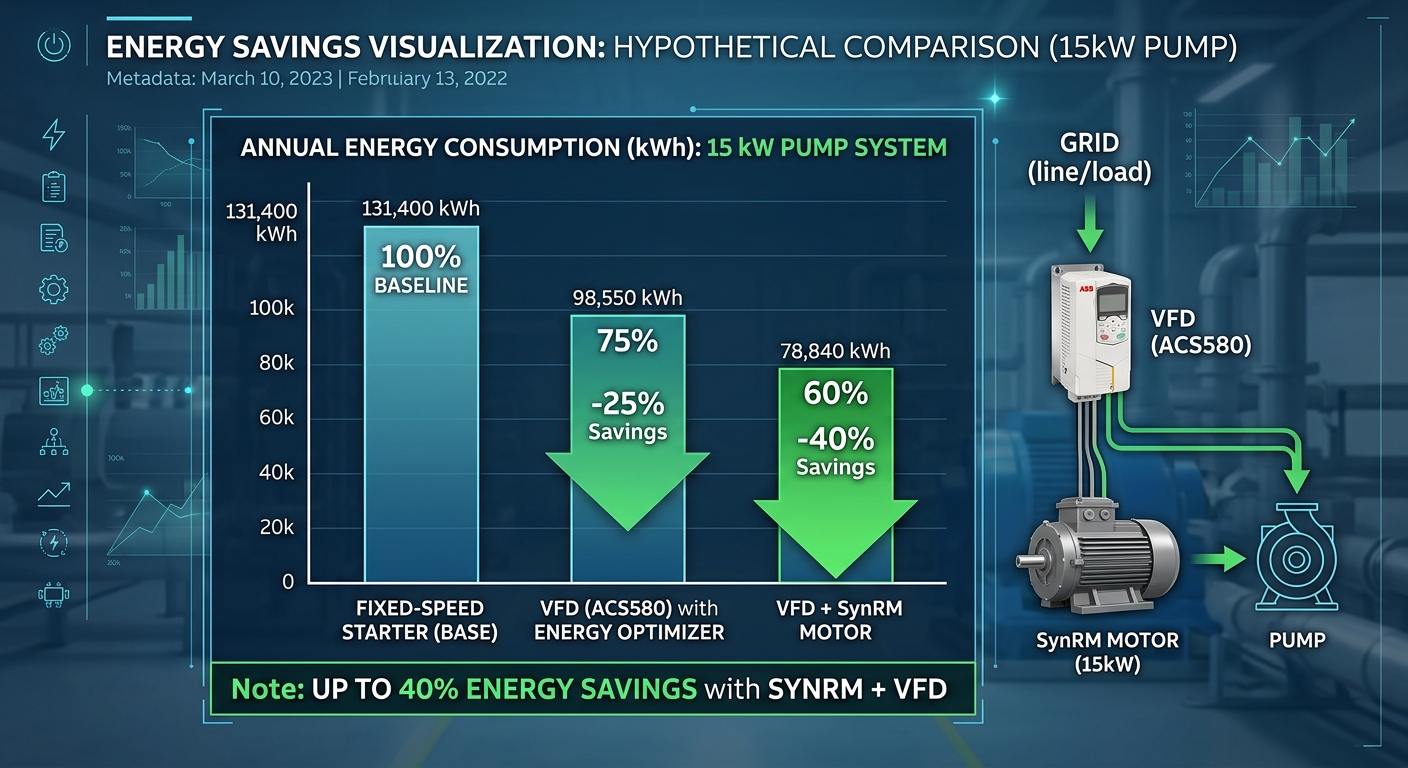
ABB’s SynRM (Synchronous Reluctance) motors, when paired with an ACS580 drive, achieve IE5 efficiency levels. The motor has no rotor copper losses, so it runs cooler and delivers higher efficiency across the speed range. For constant speed loads, a SynRM motor with a drive is often more efficient than a fixed-speed induction motor.
Energy Optimizer Function
ABB drives include a built-in energy optimizer that automatically adjusts voltage to match the load. This reduces motor heating and saves 5–15% on energy for fans and pumps running at less than full load.
Harmonic Mitigation with ACH580 Ultra-Low Harmonic Drives
For panels feeding multiple drives, harmonic accumulation can cause transformer overheating and generator problems. ABB’s ACH580 ultra-low harmonic drives meet IEEE 519 standards without external filters. Use them in high-power panels to avoid power quality penalties from distribution companies.
See the ACH580 ultra low harmonic drive range at digitalcontrols.org/products/ac-drives/ach-580-ultra-low-harmonic-drives.
Planning for Future Expansion
Design the panel with 20–30% spare I/O slots and empty mounting space for future drives or controllers. Use busbars instead of individual wires for main power distribution — this simplifies adding new feeders. Also, label all spare terminals so future electricians know they are reserved.
FAQ: Industrial Control Panel Design
1. What is the difference between heavy duty and normal duty ratings in ABB drives? Heavy duty (HD) rating means the drive can deliver its rated current continuously at an ambient temperature of 40°C, with higher overload capacity (e.g., 150% for 60 seconds). Normal duty (ND) rating assumes lower ambient or less overload. Always use HD rating for constant torque applications like conveyors, compressors, and extruders.
2. How do I calculate the minimum wire gauge for power connections inside a control panel? Use the Indian Standard IS 694 and IS 15918 tables, considering the rated current of the protective device and the ambient temperature. For VFD output cables, consider the high-frequency component; a common rule is to upsize by one gauge compared to standard power cables. Also consider voltage drop over long runs (e.g., >50 metres).
3. Can I mix ABB drives from different series in the same panel? Yes, but it adds complexity in parameter management and spares. It's better to standardise on one series (e.g., ACS580 for general purpose, ACS880 for demanding loads) to simplify commissioning and training.
4. What are the common mistakes in control panel design for Indian conditions? Undersizing the cooling system, ignoring surge protection, mixing power and control cables in the same trunking, and not providing proper earth bonding. Also, many panels lack clear labelling, which leads to extended downtime during troubleshooting.
Conclusion
Industrial control panel design is both an art and a science. By selecting the right ABB drives, PLCs, and protection devices, following best practices for layout and wiring, and using Fluke instruments for commissioning, you can build panels that stand up to the toughest Indian environments.
At Digital Controls, we support panel builders and OEMs with component sourcing, application reviews, and panel coordination services. Whether you need assistance with drive selection for a specific process or want to outsource part of your panel assembly, our team can help.
Ready to optimize your next control panel?
- Explore our complete range of ABB drives, motors, PLCs, and switchgear at digitalcontrols.org/solutions.
- For custom panel design and assembly support, visit digitalcontrols.org/services.
- Have a project query? Submit your requirements at digitalcontrols.org/enquiry.