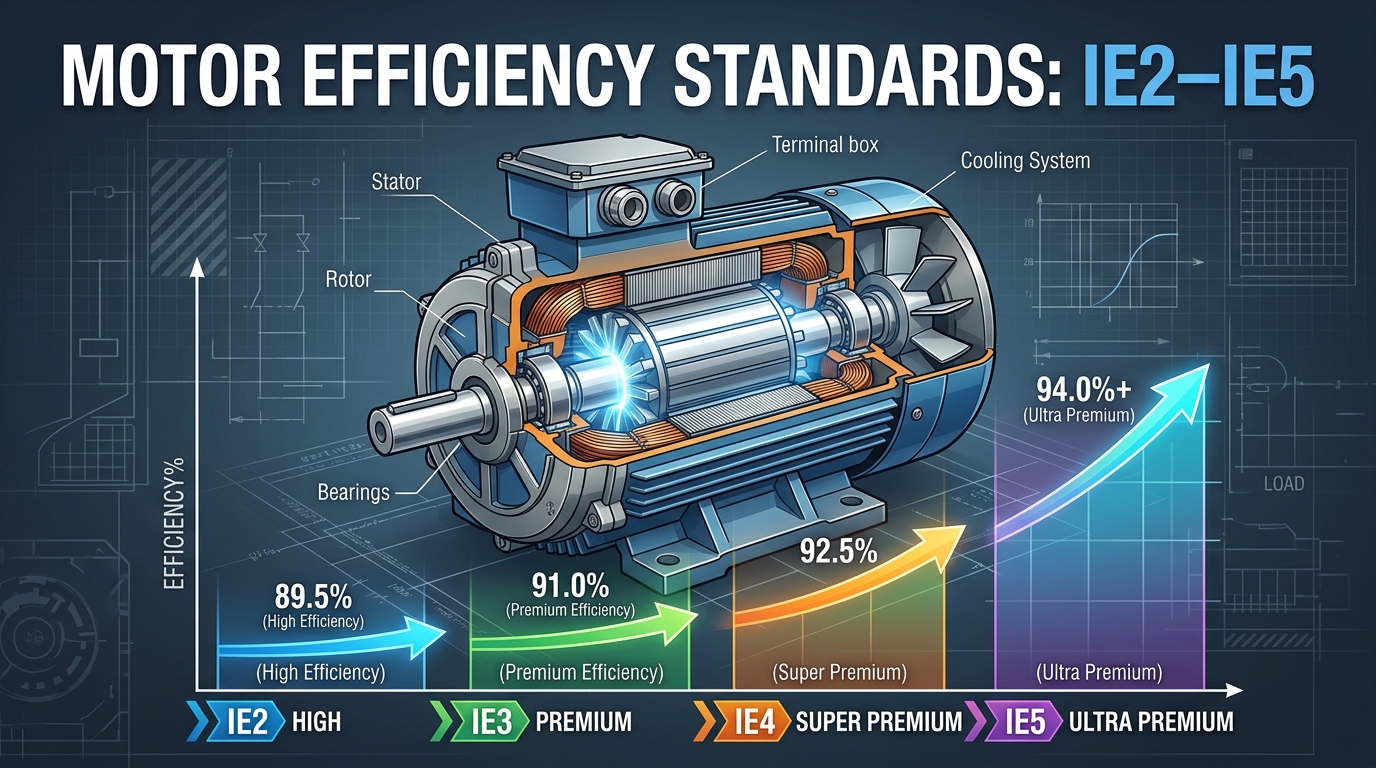
Motor Efficiency Standards: IE2, IE3, IE4 & IE5 Explained for Indian Plant Managers
Understand IE2, IE3, IE4, and IE5 motor efficiency classifications and their impact on energy costs. Expert selection guidance for plant managers evaluating motor upgrades in Indian manufacturing.
Introduction
Motor efficiency standards are the backbone of modern energy management in Indian manufacturing. Whether you are upgrading old motors or commissioning a new plant, understanding IE2, IE3, IE4, and IE5 classifications directly affects your energy bills and compliance. At Digital Controls, we help plant managers and procurement teams navigate these standards to make cost-effective, future-ready choices.
Imagine running a 75 kW motor for 6,000 hours a year. The difference between an IE2 and an IE5 motor can save over ₹3,00,000 annually in electricity costs. But which class is right for your application? This guide breaks down each level, how they reduce energy losses, and how to select the best motor efficiency standard for your plant.
What Are Motor Efficiency Standards?
Motor efficiency standards define the minimum energy performance levels for electric motors. Developed by the International Electrotechnical Commission (IEC) and adopted by the Bureau of Indian Energy Efficiency (BEE), these standards classify motors from IE1 (standard) to IE5 (ultra-premium).
Why Do They Matter?
- Energy costs account for 95–97% of a motor’s lifetime cost.
- Regulatory compliance: India mandates IE3 for most new motors above 0.75 kW (since 2022).
- Carbon footprint: Higher efficiency reduces Scope 2 emissions.
Key Classes at a Glance
| Class | Efficiency Level | Typical Applications |
|---|---|---|
| IE2 | High efficiency | Older pumps, fans – grandfathered installations |
| IE3 | Premium efficiency | Standard new installations (compliant with BEE rules) |
| IE4 | Super premium efficiency | Continuous process industries, high-duty cycles |
| IE5 | Ultra-premium efficiency | Best for variable-speed drives, SynRM motors |
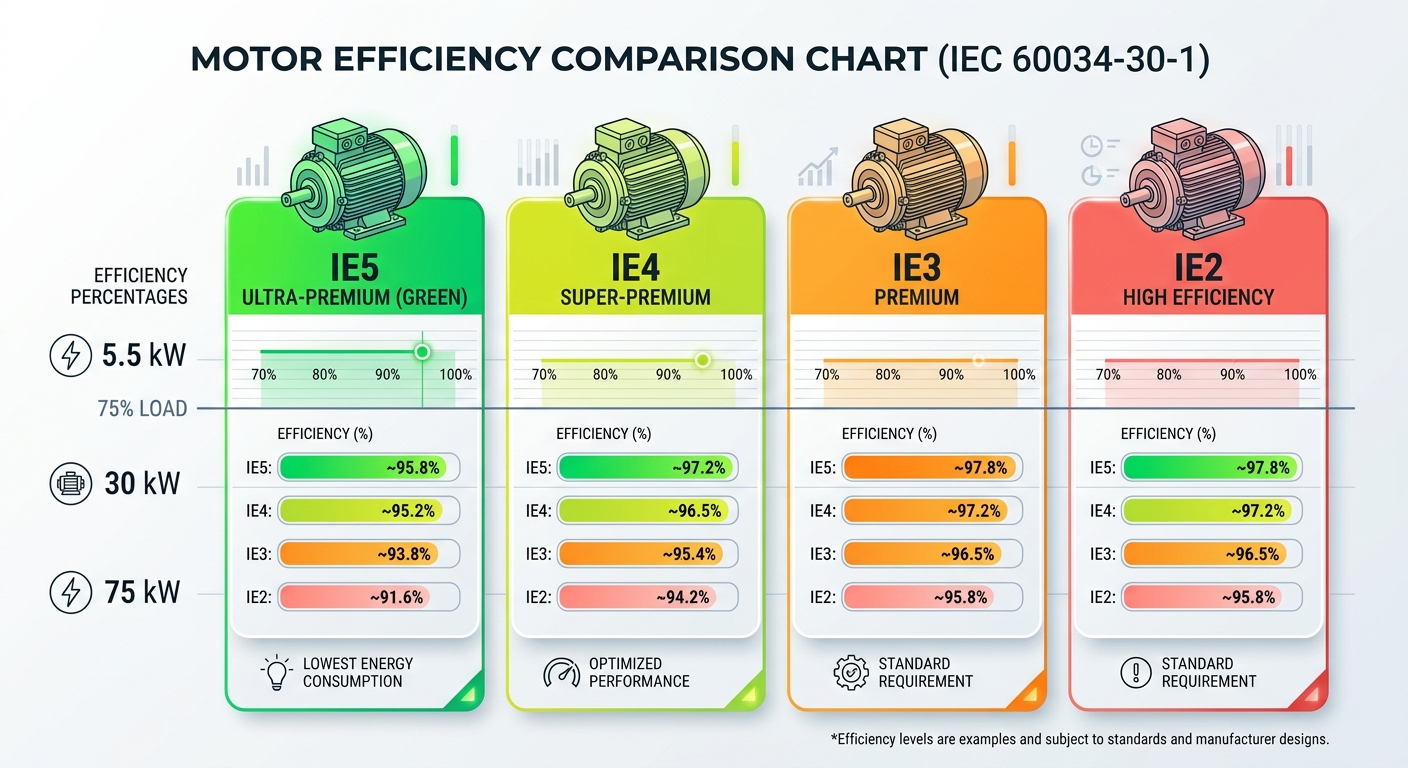 (Comparison chart showing efficiency percentage across power ratings for IE2–IE5)
IE2 vs IE3 vs IE4 vs IE5: Breaking Down the Numbers
Efficiency gains are most significant at partial loads – exactly where most motors operate when paired with variable frequency drives (VFDs). Let’s see how each class performs.
IE2 (High Efficiency) – The Baseline
- Efficiency: ~87–91% depending on power rating.
- Losses: Higher copper and iron losses.
- Use case: Only for legacy spares or low running hours (<2000 hrs/year).
- Note: IE2 motors cannot be sold for new applications in India above 0.75 kW since 2022.
IE3 (Premium Efficiency) – The New Standard
- Efficiency: ~89–94%.
- Design: Better core steel, thinner laminations, more copper windings.
- Savings: 15–20% lower energy losses vs. IE2.
- VFD compatibility: Works well, but full benefit requires matching drives.
IE4 (Super Premium) – For Intensive Operations
- Efficiency: ~92–96%.
- Technology: Often uses synchronous reluctance (SynRM) or permanent-magnet design.
- Best for: 24/7 operations like textile mills, cement plants, and water treatment.
- Payback: Typically under 18 months in energy savings.
IE5 (Ultra-Premium) – The Future
- Efficiency: >96% (beyond IEC 60034-30-2 minimum).
- Design: Only possible with SynRM or PM motors – no traditional induction motor can reach this.
- Ideal partner: ABB’s SynRM motors paired with ACS drives can achieve IE5.
- Cost premium: Higher initial capex, but life-cycle savings are substantial.
How to Choose the Right Motor Efficiency Standard for Your Plant
Selecting a motor efficiency class isn’t just about the highest number. You must consider duty cycle, load profile, VFD usage, and total cost of ownership. Here’s a step-by-step approach.
Step 1: Calculate Annual Operating Hours
- <2000 hrs/year: IE3 is usually cost-optimal.
- 2000–6000 hrs/year: IE4 becomes attractive.
-
6000 hrs/year: IE5 or IE4 with SynRM yields best ROI.
Step 2: Evaluate Load Variation
- Constant load (e.g., pumps at fixed speed): IE3 induction motor is adequate.
- Variable load (e.g., conveyor, fan with VFD): IE4 SynRM or IE5 provides 5–8% additional savings because drive/motor losses scale non-linearly.
Step 3: Check Drive Compatibility
ABB’s unified drive family (ACS180, ACS380, ACS580, ACS880) supports all efficiency classes, but for IE4/IE5 you need drive software that handles synchronous motors. Using a standard VFD with a SynRM motor without proper control will not achieve rated efficiency.
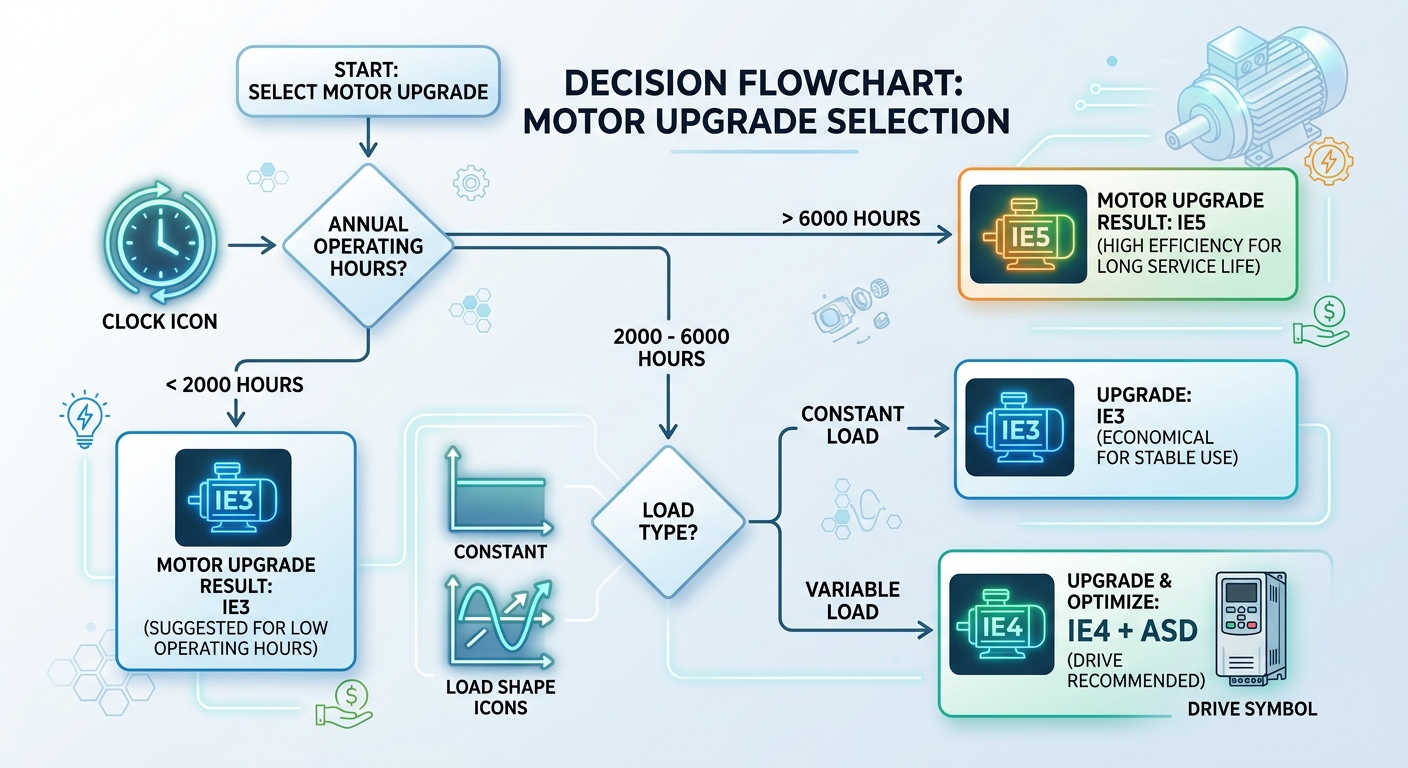 (Flowchart: Motor upgrade decision tree – start with operating hours, then load type, then VFD usage)
Step 4: Factor in BEE Regulations
As of 2024, India’s BEE mandates IE3 for all motors from 0.75 kW to 375 kW sold for new applications. When retrofitting, consult our team at Digital Controls for compliance guidance.
Impact of Motor Efficiency Standards on Energy Costs – A Real Example
Consider a 30 kW motor running 8,000 hours/year at 80% average load. Electricity rate ₹8/kWh.
| Class | Efficiency at 75% load | Annual Energy (kWh) | Annual Cost (₹) |
|---|---|---|---|
| IE2 | 90.0% | 213,333 | 17,06,664 |
| IE3 | 92.5% | 207,567 | 16,60,536 |
| IE4 | 94.5% | 203,175 | 16,25,400 |
| IE5 | 96.0% | 200,000 | 16,00,000 |
Savings from IE2 to IE5: ₹1,06,664 per year – that’s the cost of 2–3 new motors every year.
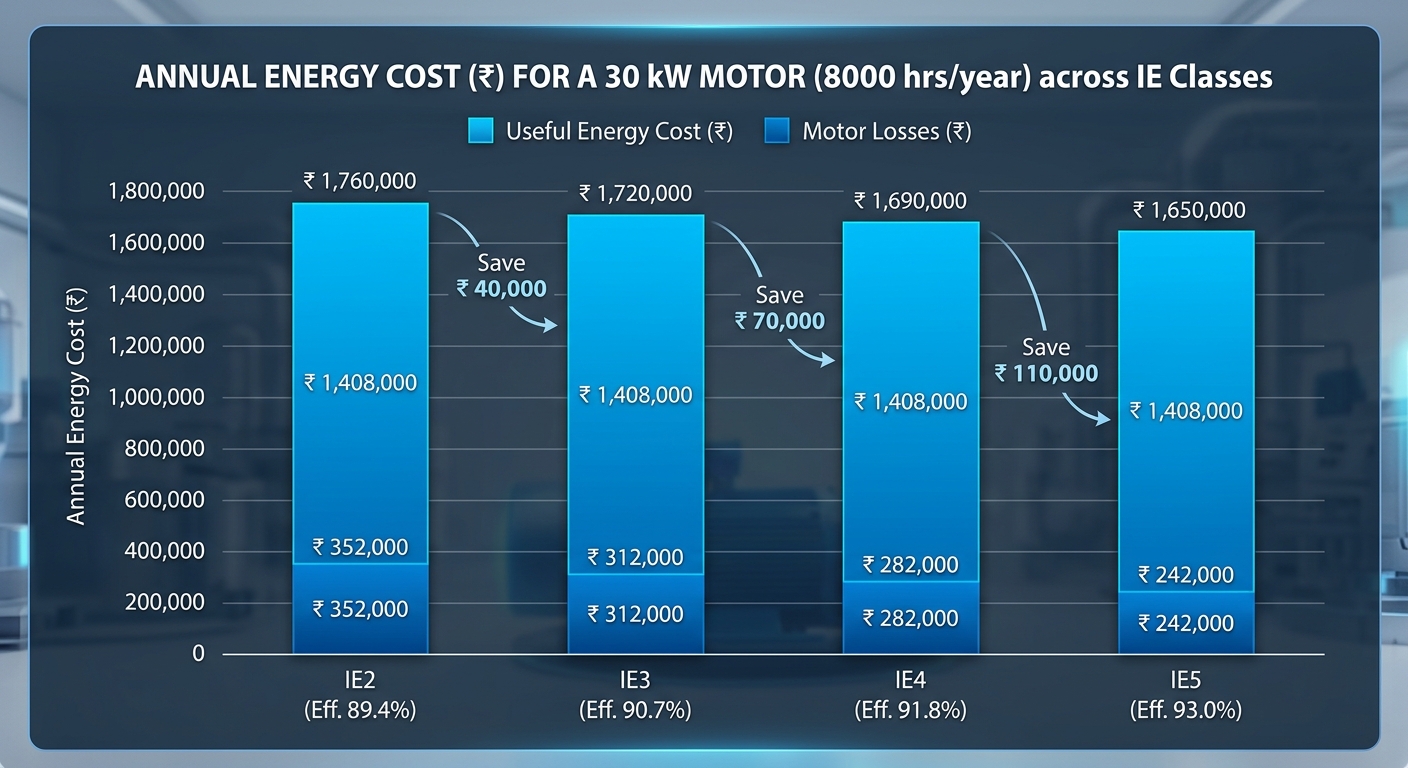 (Bar chart comparing annual energy cost for each class)
Optimizing Efficiency with VFDs and Motor Packages
The true potential of motor efficiency standards unlocks when combined with variable frequency drives. ABB’s EnergySave packages pair IE4/IE5 motors with compatible drives and pre-configured control logic. This reduces installation time and ensures measured savings.
Why Drive-Motor Matching Matters
- Harmonics: Drives with low harmonic content (like the ACH580 Ultra Low Harmonic Drive) improve motor life.
- Control panel coordination: Our engineers review your existing panel layout and recommend the right combination – saving you from rewiring later.
- Commissioning support: We provide on-site tuning to verify efficiency at your actual operating point.
For Indian projects, sourcing from a single supplier like Digital Controls eliminates compatibility guesswork. We offer the full ABB motor and drive portfolio along with pre-wired control panels.
Future-Proofing Your Plant: Transitioning to IE4/IE5
Indian industry is moving toward energy optimization as a competitive advantage. The BEE is expected to mandate IE4 for select power ranges by 2027. Investing in IE5 motors now positions your plant ahead of regulations.
Practical Steps for a Motor Upgrade Program
- Audit your motor fleet: Use a Fluke power quality analyzer to measure actual loading. (Our Fluke test instruments can help.)
- Identify top energy consumers: Replace those first with IE4 or IE5.
- Verify drive compatibility: Upgrade drives if needed. Our AC Drives selection tools simplify this.
- Set up monitoring: Install energy meters and leverage ABB’s digital services to track savings.
Frequently Asked Questions (FAQ)
Q1: Can I use an IE5 motor with an existing VFD?
Not always. IE5 motors are typically synchronous reluctance (SynRM) and require a drive with sensorless or encoder-based control. ABB’s ACS580 and ACS880 series support SynRM directly. Check with us for specific compatibility.
Q2: Are IE3 motors still allowed in India?
Yes, IE3 is the current minimum for new motors (0.75–375 kW) as per BEE. IE2 motors can only be used as spares for existing installations.
Q3: What is the payback period for upgrading from IE2 to IE4?
For a 30 kW motor running 6,000 hours/year, payback is typically 12–18 months. After that, pure savings.
Q4: Do motor efficiency standards apply to DC motors?
No, these standards cover AC induction and synchronous motors only. For DC drives, consult our DC Drives page for efficiency considerations.
Conclusion
Understanding motor efficiency standards – from IE2 to IE5 – is the first step toward cutting your plant’s energy costs and staying compliant with Indian regulations. By matching the right efficiency class to your application, duty cycle, and drive system, you can achieve substantial savings with a clear payback.
At Digital Controls, we provide end-to-end support: from motor selection using ABB’s digital tools, to control panel coordination, to commissioning. Whether you need an IE3 replacement or a full IE5 SynRM solution, our team ensures you get measurable results.
Learn more about our motor and drive solutions or contact our engineering team for a free energy savings assessment.