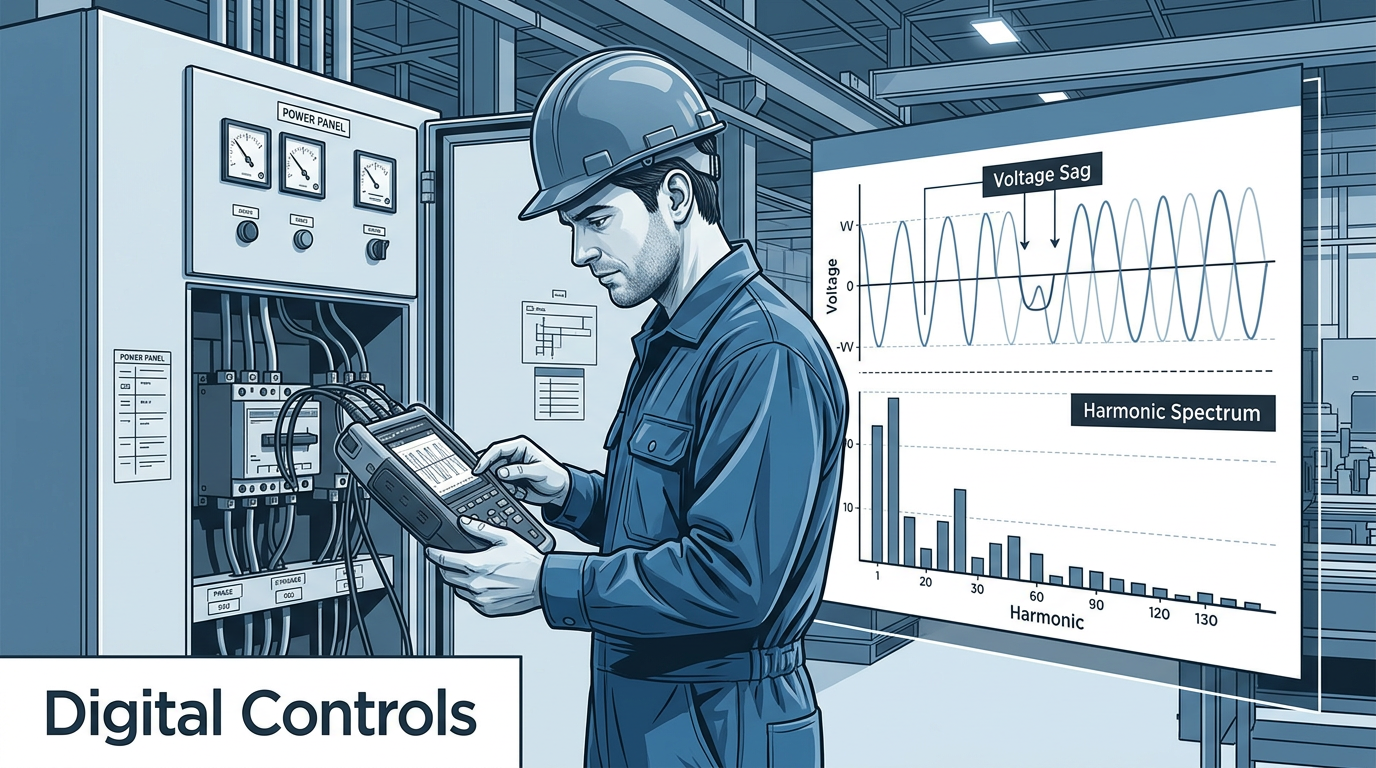
Power Quality Testing in Indian Industries: Fluke Solutions & Expert Support
Comprehensive guide to power quality testing for Indian industrial facilities using Fluke instruments. Covers common PQ issues, diagnostic techniques, and how expert interpretation services drive efficiency.
Electrical engineers and plant managers across Indian manufacturing units face a silent productivity killer: poor power quality. Voltage sags, harmonics, transients, and unbalance not only damage sensitive equipment like ABB drives and PLCs but also inflate energy bills and cause unplanned downtime.
Power quality testing is the first step toward identifying these issues and implementing corrective measures. At Digital Controls, we combine Fluke’s industry-leading test instruments with expert interpretation services to help you pinpoint root causes and justify investments in power conditioning.
This article walks you through common power quality problems in Indian industries, the right Fluke instruments for each scenario, and how our team turns raw data into actionable plant improvements.
Why Power Quality Matters More Than Ever in Indian Manufacturing
India’s industrial power landscape is notoriously volatile. Grid fluctuations, shared feeders, and the proliferation of non-linear loads — such as variable frequency drives (VFDs), UPS systems, and LED lighting — create a cocktail of disturbances.
According to a 2023 study by the Bureau of Energy Efficiency, poor power quality accounts for up to 8% of total electrical energy waste in Indian factories. For a plant with a monthly electricity bill of ₹50 lakh, that’s ₹40,000 lost every month — money that could fund process improvements or new equipment.
Neglecting power quality not only wastes energy but also shortens the lifespan of motors, drives, and control panels. For example, harmonic currents circulating through an ABB ACS580 drive can cause premature capacitor failure in the DC bus, leading to unplanned replacement costs.
The Hidden Costs of Ignoring Power Quality
- Equipment damage: Reduced insulation life in motors (up to 50% shorter) due to harmonic heating.
- Production losses: Tripping of sensitive PLCs or CNC machines during voltage sags.
- Energy penalties: Power factor penalties from utilities (common in states like Gujarat, Maharashtra, Tamil Nadu).
- Higher maintenance: Frequent fuse blowing, nuisance breaker trips, and overheating of neutral conductors.
Proactive power quality testing using instruments like Fluke’s 435 Series II helps engineers quantify these losses and build a business case for mitigation.
Understanding Common Power Quality Issues in Indian Facilities
To interpret test results correctly, you need to understand the most frequent disturbances found on Indian industrial networks.
Voltage Sags and Swells
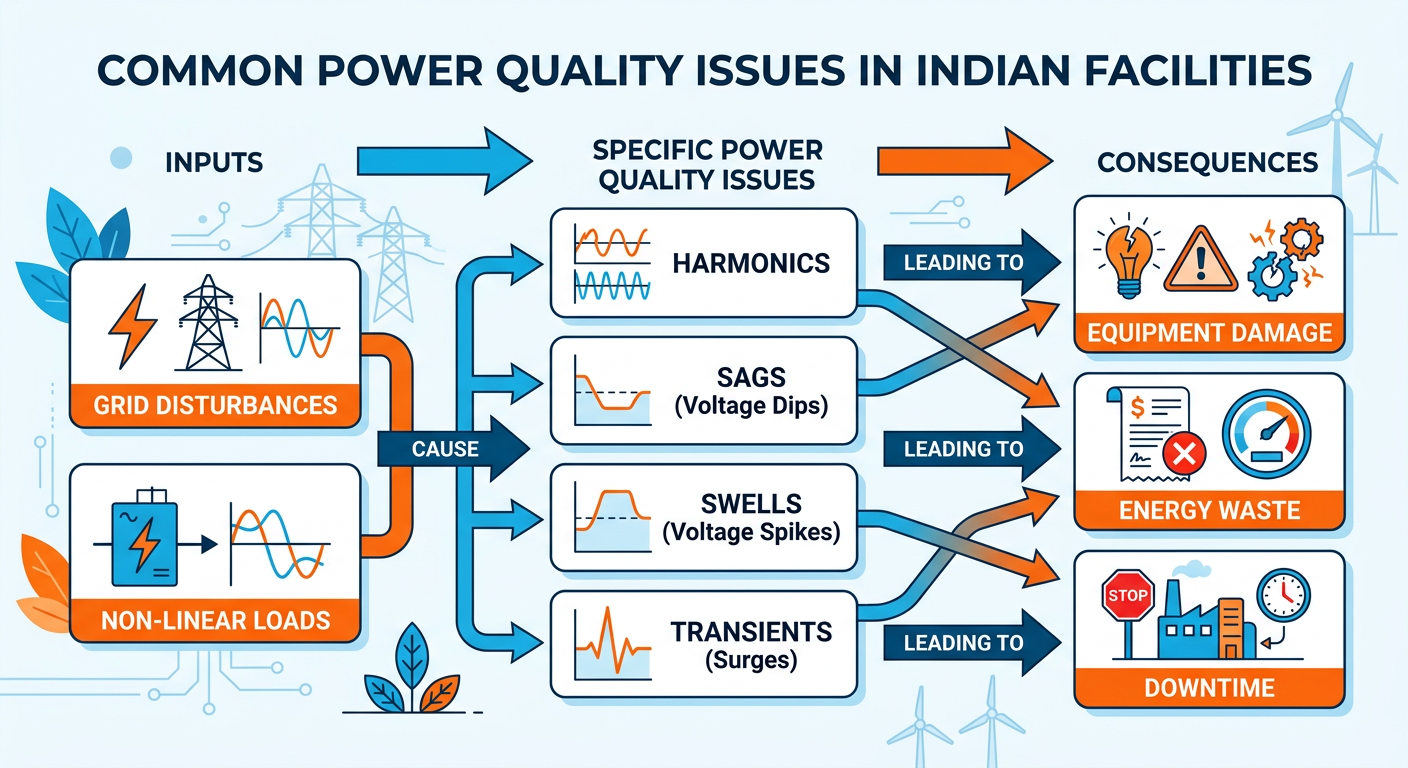
Voltage sags are momentary drops (typically 10–90% of nominal voltage for half a cycle to one minute). They are the most common PQ event and are often caused by remote faults, starting of large motors, or switching of capacitor banks.
In India, voltage swells (overvoltage) are less frequent but equally damaging — often due to sudden load shedding or faulty tap changers on distribution transformers.
Harmonics – The Silent Current Distortion
Harmonics are integer multiples of the fundamental frequency (50 Hz in India). They are generated by non-linear loads like VFDs, rectifiers, and arc furnaces.
For example, a six-pulse rectifier in an ABB ACS880 drive produces significant 5th and 7th harmonics. If left unchecked, these harmonics can overload transformers, cause capacitor bank failures, and interfere with communication systems.
The standard IEEE 519-2014 defines acceptable harmonic limits. A power quality analyzer can capture the Total Harmonic Distortion (THD) and individual harmonic spectrum to check compliance.
Transients and Surges
Transients are short, high-energy spikes (lasting microseconds) that can destroy semiconductor devices in drives and PLCs. Lightning strikes, capacitor switching, and large load disconnections are common sources.
Power Factor Issues
Many Indian plants operate with a lagging power factor (typically 0.7–0.9) due to induction motors. While capacitor banks are used for correction, harmonic resonance can occur if the bank is not properly tuned.
Power factor testing is part of any comprehensive power quality audit. Fluke’s 1730 three-phase power logger provides real-time PF data along with voltage and current trends.
Fluke Instruments for Power Quality Testing: Which to Choose?
Fluke offers a range of instruments designed for different levels of testing — from quick troubleshooting to long-term compliance monitoring.
For Comprehensive Analysis: Fluke 435 Series II / 437 Series
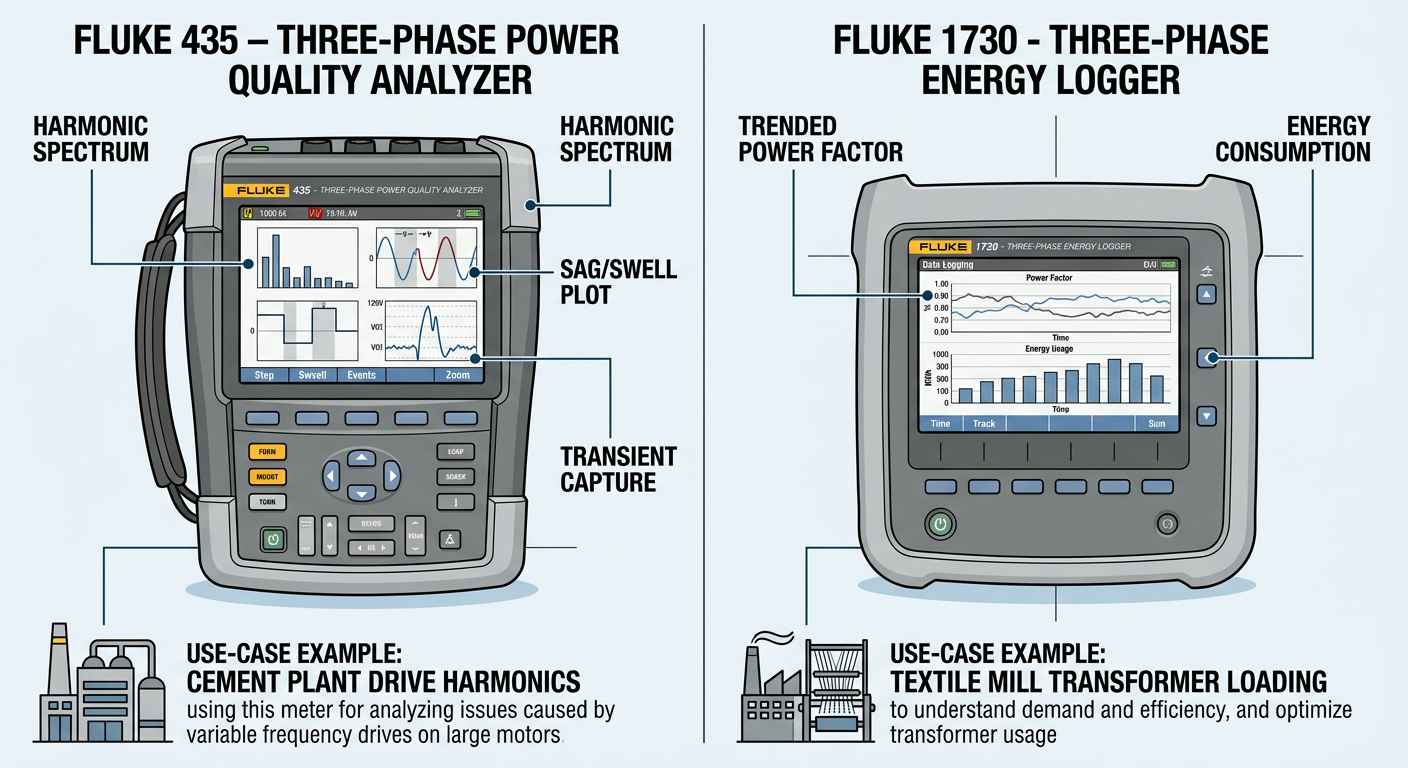
These three-phase power quality analyzers are the gold standard for industrial testing. They can measure all key parameters:
- Voltage and current harmonics up to the 50th order.
- Voltage sags, swells, and interruptions with time-stamping.
- Transients up to 6 kV.
- Power factor, active/reactive power, and energy consumption.
Use case: A cement plant in Rajasthan used the Fluke 435 to identify that a 200 kW ID fan’s drive was injecting 12% THD into the bus, causing neighboring PLCs to reset. The data was used to justify adding a line reactor and tuning the drive’s DC link.
For Spot Checks and Basic Audits: Fluke 1730 / 1732 Three-Phase Power Loggers
These instruments are simpler to set up and ideal for energy audits and basic PQ screening. They log voltage, current, power, and power factor over days or weeks.
Use case: A textile mill in Tamil Nadu deployed the Fluke 1730 for a week-long study and discovered that a 500 kVA transformer was consistently overloaded during night shifts due to harmonic circulating currents. The data helped redesign the load distribution.
For Motor and Drive Testing: Fluke 190 Series ScopeMeter
While not a dedicated PQ analyzer, the ScopeMeter is invaluable for capturing transient events and drive output waveforms. It helps troubleshoot drive commutation issues, IGBT faults, and motor cable reflections.
Use case: An ABB ACS580 drive was tripping intermittently. The Fluke 190 captured a high-frequency ringing on the output cables, indicating a long cable run without a dV/dt filter. Adding the filter solved the problem.
Step-by-Step Guide to Conducting a Power Quality Test
If you are planning to perform a power quality test at your facility, follow these steps to ensure accurate, actionable results.
Step 1: Define the Test Objective
- Are you troubleshooting a specific problem (e.g., drive tripping)?
- Are you conducting a baseline audit for energy savings?
- Are you verifying compliance with IEEE 519 or state electricity board regulations?
Step 2: Select the Right Measurement Point
Install the analyzer at the point of common coupling (PCC) — typically the main incoming feeder or the bus feeding the suspect equipment. For drive-related issues, measure at the drive input and output.
Step 3: Set Up the Fluke Analyzer
- Connect voltage leads (phase-to-neutral or phase-to-phase as needed).
- Install current clamps around each phase (ensure correct orientation).
- Configure the instrument for the local grid (230/400V, 50 Hz).
- Set the trigger thresholds for sags (e.g., 90% of nominal), swells, and transients.
Step 4: Start Recording and Monitor
Run the test for at least one full production cycle (24–72 hours) to capture all variations. For intermittent issues, longer monitoring (7–14 days) may be required.
Step 5: Download and Interpret Data (The Critical Step)
Raw data from a Fluke analyzer includes hundreds of thousands of events. Interpreting these results correctly requires experience. For example, a voltage sag might be caused by a downstream fault, a grid event, or even a large motor starting — each has a different remedy.
Expert Interpretation: Why Data Alone Is Not Enough
Many plant teams purchase a Fluke analyzer but struggle to turn reports into concrete actions. That’s where Digital Controls’ power quality testing services come in.
Our engineers have decades of experience with ABB drives, control panels, and industrial electrical systems. When you partner with us, we:
- Analyze the captured data in context of your plant’s load profile.
- Identify whether harmonics are being generated by specific drives (like an unloaded conveyor running at 30 Hz) or by the entire system.
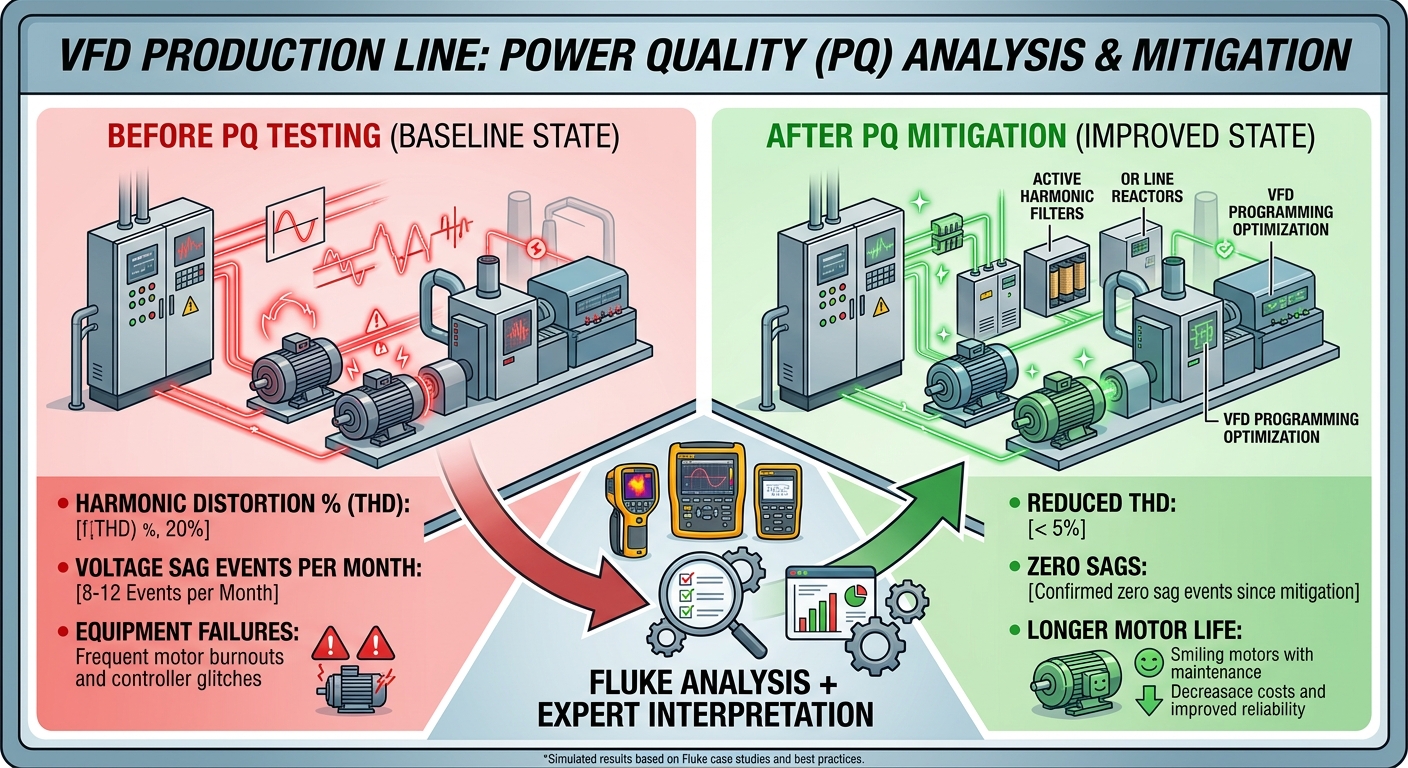
- Recommend corrective measures: line reactors, harmonic filters, active front-end drives (e.g., ABB’s ACS880-01 with built-in filtering), or power factor correction tuning.
- Provide a detailed report that you can use for CAPEX approvals or utility negotiations.
For example, we recently helped a pharmaceutical company in Hyderabad. Their Fluke 435 data showed an 8% voltage imbalance at the mains. Our team traced it to an incorrectly tapped transformer — fix cost: ₹15,000. The plant avoided a ₹45 lakh investment in a new UPS they were considering.
Linking Power Quality to Drive and Motor Performance
ABB drives are sensitive to power quality. Poor voltage supply leads to DC bus instability, harmonic overheating, and nuisance trips. Conversely, drives themselves inject harmonics back into the grid.
If you are using ABB drives (ACS180, ACS380, ACS580, ACS880 series), you should routinely check:
- Input voltage THD < 5% at PCC (per IEEE 519).
- Drive output voltage to motor — check for overvoltage or reflected wave spikes, especially with long cables.
- Power factor at the drive input — low PF may indicate a failed diode bridge or capacitor.
In many installations, adding a line reactor or a dU/dt filter can resolve PQ issues without replacing the drive. Our team can recommend the right filter based on your Fluke test results.
For plants looking to minimize harmonics at the source, ABB’s ACH580 Ultra Low Harmonic Drives (which we supply and commission) reduce THD to below 5% without external filters. They are ideal for facilities where strict grid compliance is required.
FAQ: Power Quality Testing in Indian Industries
Q1: How often should I conduct power quality testing in my plant?
For most facilities, an annual comprehensive audit using a Fluke 435 is sufficient. However, if you have recently added new drives, changed the transformer, or experienced unexplained trips, perform a targeted test immediately.
Q2: Can poor power quality damage my ABB drive’s IGBT modules?
Yes. High dv/dt transients and voltage sags can stress IGBT junctions, leading to premature failure. A Fluke ScopeMeter can capture these events and help you decide if a filter or surge protector is needed.
Q3: What is the difference between a power quality analyzer and a multimeter?
A multimeter measures steady-state RMS values. A power quality analyzer (like Fluke 435) captures dynamic events, harmonic content, and timestamps disturbances — essential for diagnosing intermittent problems.
Q4: Does Digital Controls provide on-site power quality testing?
Yes. Our services team can visit your site, set up Fluke instruments, monitor for the required duration, and deliver a comprehensive analysis with recommendations. Contact us through the enquiry page to schedule.
Conclusion: Take Control of Your Power Quality
Poor power quality is an invisible drain on your plant’s efficiency and equipment life. With Fluke’s advanced instruments and Digital Controls’ technical expertise, you can not only power quality testing accurately but also implement corrective actions that deliver measurable ROI.
Whether you need to rent a Fluke 435 for a week-long audit, purchase a new analyzer for your maintenance team, or hire our experts to turn data into action — we are here to help.
Get started today:
- Browse our Fluke Instruments range.
- See how our services can support your next audit.
- Contact us for a free consultation on your power quality challenge.
Don’t let hidden electrical problems reduce your competitiveness. Test, diagnose, and optimize with Digital Controls.