SynRM Motor Drive Combination Benefits: ABB’s Efficiency Edge for Indian Manufacturing
Discover how ABB’s SynRM motor and VFD combination delivers up to IE5 efficiency, lower energy costs, and reliable performance for Indian OEMs and project engineers.
When your production line depends on motors that run 16 hours a day, six days a week, even a 2% efficiency gain translates into lakhs of rupees saved annually. That is exactly what the SynRM motor drive combination benefits deliver for Indian manufacturers. ABB’s synchronous reluctance motors, paired with a compatible variable frequency drive, are quickly becoming the go-to solution for OEMs and project engineers who want to cut energy bills without compromising torque or reliability.
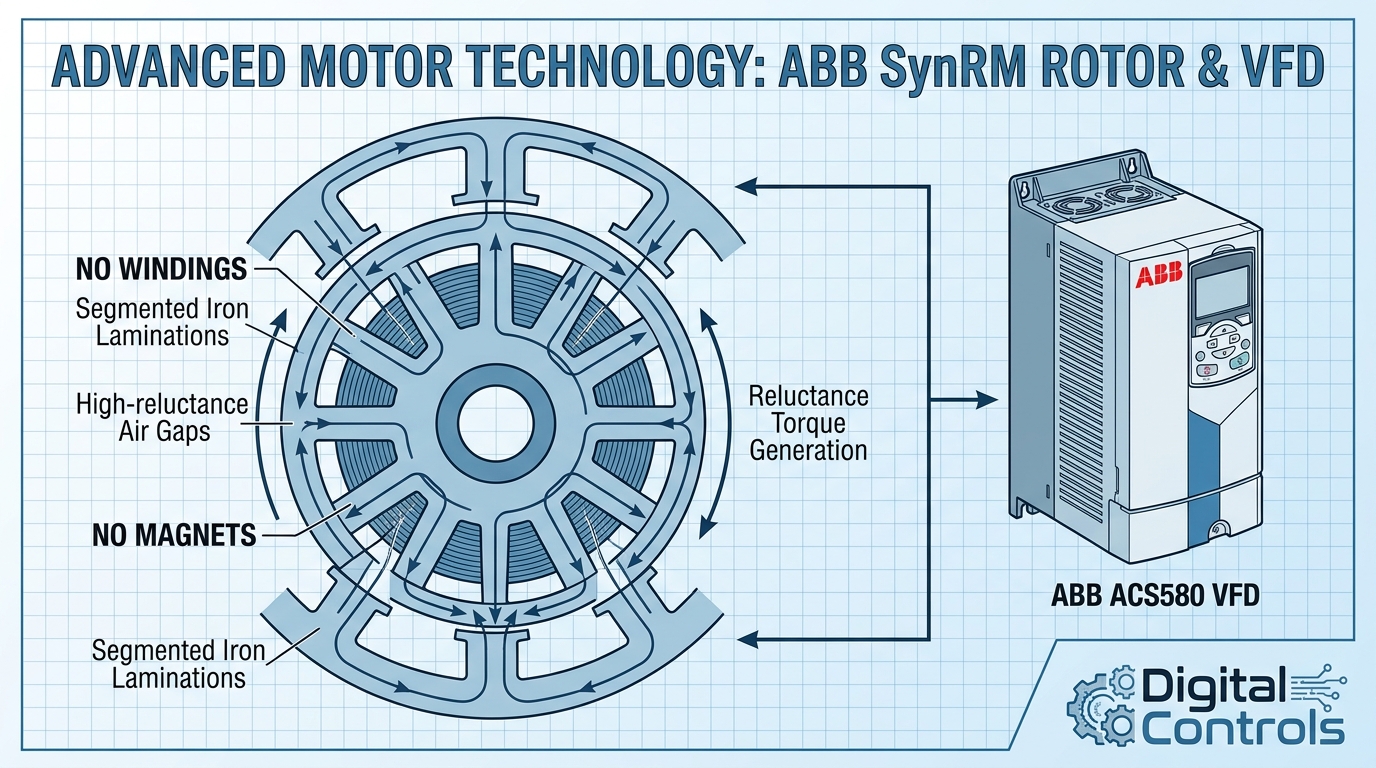
Unlike conventional induction motors, SynRM rotors contain no magnets or windings. They rely on magnetic reluctance to create torque, which means lower rotor losses, less heat, and a motor that runs cooler even at partial loads. When you couple that with an ABB drive — say the ACS580 or ACS880 — the system becomes a true energy-optimised package.
Why SynRM Motor Drive Combination Benefits Matter Right Now
India’s industrial sector accounts for nearly 40% of total electricity consumption, and motors are responsible for about 70% of that. With tightening BEE (Bureau of Energy Efficiency) standards and rising power tariffs, plant managers are under pressure to move beyond IE3 and even IE4 to the new IE5 ultra-premium efficiency class.
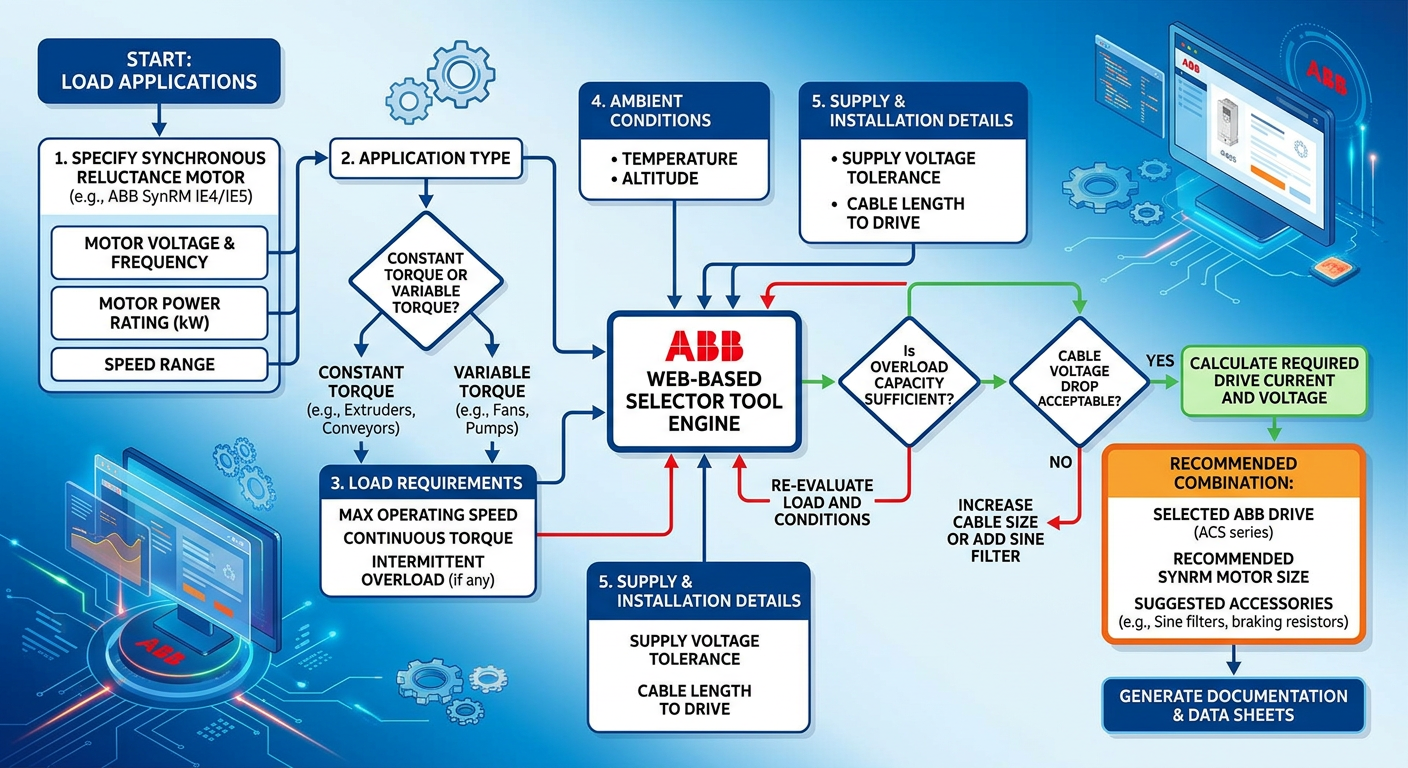
ABB’s SynRM motors achieve IE5 efficiency across most of the operating range — something a standard induction motor cannot do without a permanent magnet. The key enabler is the drive. A SynRM motor cannot run directly on line power; it needs a VFD to control the stator current vector and maintain synchronism. That is why understanding the SynRM motor drive combination benefits is critical for your next motor procurement.
What Makes SynRM Different from Induction and PM Motors?
- No rotor windings or magnets — eliminates copper losses and magnet demagnetisation risks.
- Lower operating temperature — extends bearing and insulation life.
- High efficiency at partial load — ideal for pumps, fans, and compressors that rarely run at 100%.
- Smooth torque without cogging — reduces mechanical stress on driven equipment.
When you combine a SynRM motor with an ABB drive, the drive’s built-in flux optimisation and sensorless vector control algorithms maximise the motor’s reluctance torque, giving you the best of both worlds: induction motor robustness and PM motor efficiency.
Pairing SynRM Motors with ABB Drives: A Compatible Family
ABB’s drive portfolio — the ACS180, ACS380, ACS580, and ACS880 — is designed as an all-compatible family, meaning you can match any SynRM motor with the right drive without worrying about compatibility conflicts. This unified platform simplifies selection, especially when you are standardising across multiple plant lines.
For example, the ACS580 ultra-low harmonic drives pair exceptionally well with SynRM motors in applications where power quality is a concern. The drive’s built-in harmonic filtering reduces THD to below 5%, which is vital for plants with sensitive PLCs or multiple drives on the same bus.
Application-Specific Sizing: Constant Torque vs Variable Torque
One of the most common mistakes in drive selection is simply matching the motor nameplate kW. But SynRM motor drive combination benefits are only fully realised when you correctly size the drive for the load profile:
- Constant torque (heavy duty): Conveyors, extruders, crushers — require high starting torque. Use a drive rated for 110-120% overload for 60 seconds.
- Variable torque (normal duty): Centrifugal pumps, fans — torque varies with speed squared. A standard duty drive (100% overload) is sufficient, and SynRM motors shine here because they maintain IE5 efficiency even at 25% flow.
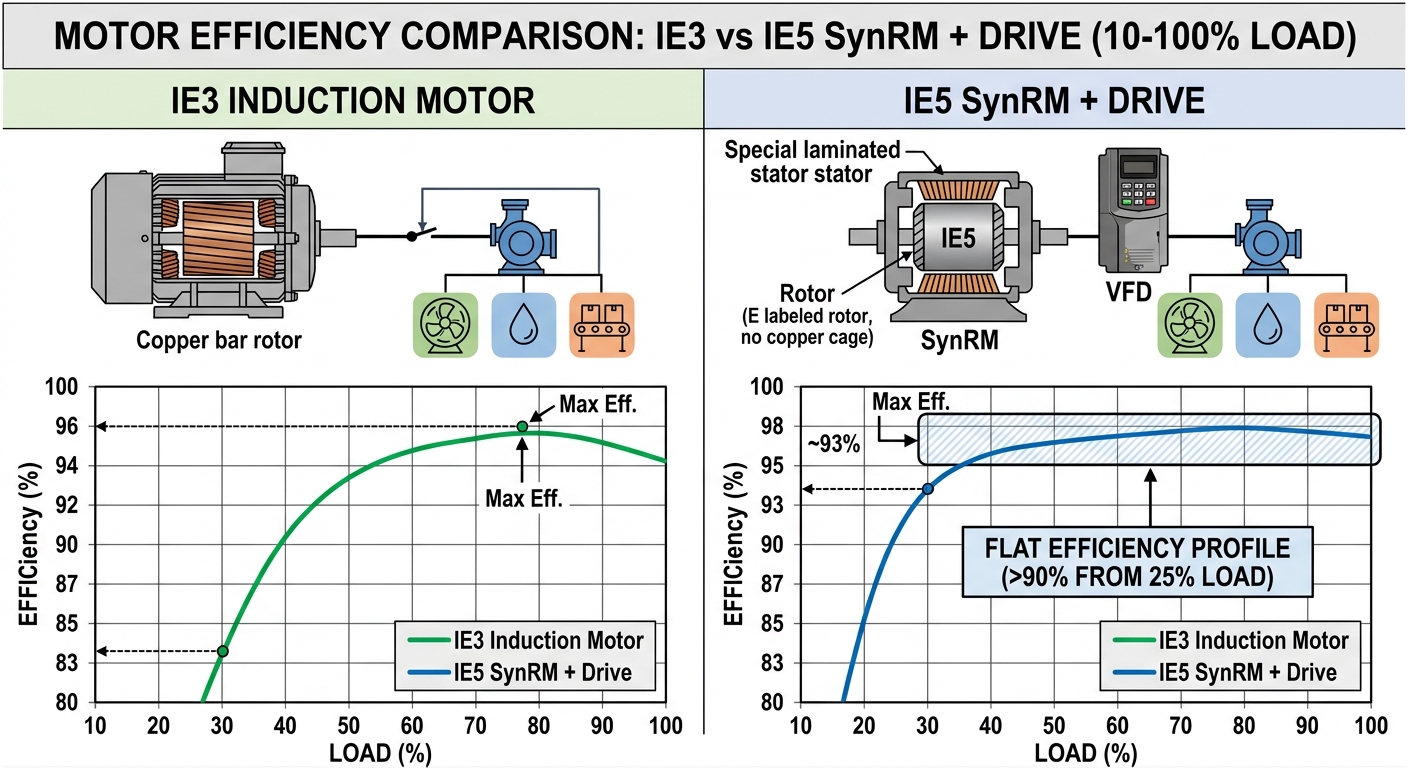
ABB’s web-based drive selector tool now replaces manual datasheet comparison. You answer a few guided questions — load type, ambient temperature, cable length — and it recommends the optimal SynRM + drive combination. This is especially helpful when you are evaluating multiple bids across projects.
Quantifying the Efficiency Gains: Data That Matters
Let’s put numbers on the SynRM motor drive combination benefits. Consider a 37 kW fan motor running 6000 hours per year in a cement plant:
| Motor Type | Efficiency at 75% load | Annual Energy Consumption (kWh) | Annual Cost (₹9/kWh) |
|---|---|---|---|
| IE3 induction | 94.0% | 223,404 | ₹20.1 lakh |
| IE4 SynRM + drive | 96.5% | 217,617 | ₹19.6 lakh |
| IE5 SynRM + drive | 97.0% | 216,495 | ₹19.5 lakh |
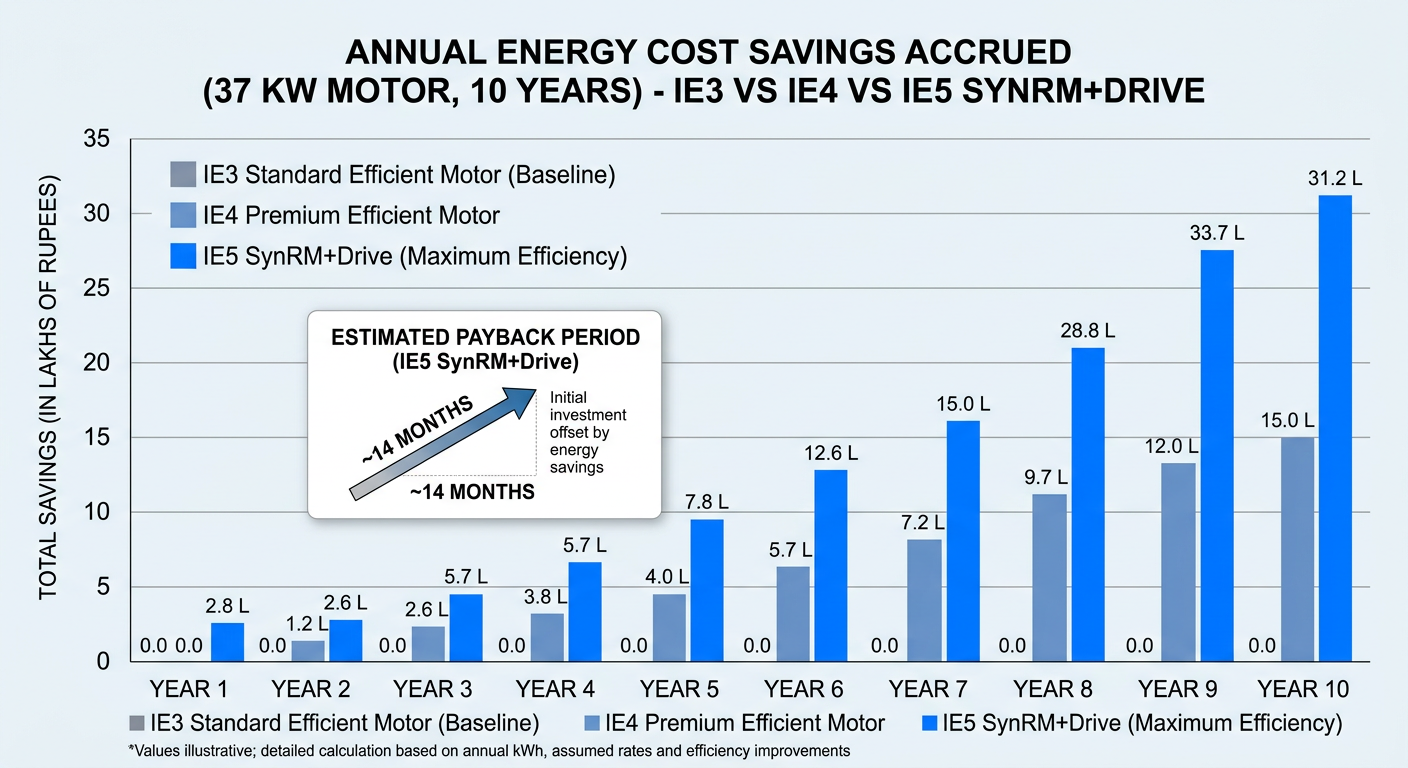
The IE5 SynRM + drive combination saves ₹60,000 per year compared to the IE3 induction motor. Over a 10-year motor life, that is ₹6 lakh — far more than the incremental cost of the SynRM system. Add in reduced maintenance (no rotor heat, less bearing wear), and the total cost of ownership becomes compelling.
Practical Considerations for Indian OEMs and Panels Builders
If you are designing a control panel for a new machine or retrofitting an existing line, here are key points to discuss with your ABB supplier:
1. Drive Cabinet Integration
SynRM motors do not require any special cabling, but the drive must be configured for SynRM control. All modern ABB drives have a dedicated motor control mode for synchronous reluctance. Ensure the commissioning engineer selects this mode during setup, not the default induction motor mode.
2. Harmonic Management
When multiple drives are mounted in a single panel, harmonics can interact. ABB’s ACS880 series offers built-in active supply units that eliminate harmonics at the source — ideal when you are running multiple SynRM motors on a common DC bus.
3. Backup and Service Spares
Because SynRM motors are still less common than induction motors, keep a spare drive module or a complete spare motor for critical applications. ABB’s all-compatible drive family means you can swap a larger ACS880 drive for a smaller SynRM motor in an emergency — the drive auto-tunes to the motor parameters.
4. Commissioning Support from Digital Controls
Our commissioning support services include on-site parameterisation of SynRM drives, load testing with Fluke power analysers, and training for your maintenance team. We have seen installations where improper gain tuning caused torque ripple; our engineers dial in the vector control loops on site.
Troubleshooting Common SynRM + Drive Issues
Even with the best components, issues can arise. Here is what to check when commissioning:
- Motor overheating at low speed: Ensure the drive’s fan cooling is enabled and that you have selected the correct motor thermal model. SynRM motors generate very low rotor heat, but stator cooling is still needed.
- Torque dip at certain speeds: This is often caused by resonance between the drive’s switching frequency and the motor’s natural frequencies. Use the drive’s skip frequency feature to avoid those bands.
- Drive tripping on overcurrent: Verify that the motor cable length does not exceed the drive’s maximum specified distance. For long cable runs (over 100 metres), add output dV/dt filters.
Using a Fluke 438-II power quality analyser during commissioning lets you measure actual motor efficiency, harmonics, and torque in real time. This data also helps you justify the investment to your finance team.
The Role of Energy Efficiency in Manufacturing Cost Reduction
The shift from basic motor control to energy optimisation is accelerating across Indian manufacturing. ABB’s EnergySave packages — which bundle SynRM motors, drives, and commissioning — are gaining traction in industries like textiles, chemicals, and food processing.
A recent upgrade in a Pune-based chemical plant replaced 18 IE3 induction motors with SynRM + ACS580 combinations. The result? A 12% reduction in plant-wide motor energy consumption, translating to ₹18 lakh annual savings. Payback period: 14 months.
FAQ: SynRM Motor Drive Combination Benefits
1. Can SynRM motors replace existing induction motors without changing the drive?
No, SynRM motors require a compatible VFD with synchronous reluctance control mode. Older induction motor drives may not have the necessary software. If you are upgrading, you need a new drive — ideally from ABB’s ACS family — to unlock the full efficiency gains.
2. What is the typical payback period for a SynRM motor drive combination?
For applications with high operating hours (6000+ per year), payback is usually 12–24 months depending on local electricity tariffs. For constant torque loads like conveyors, payback may extend to 2–3 years, but the long-term savings still justify the investment.
3. Are SynRM motors suitable for hazardous area applications?
Yes, ABB offers SynRM motors in Ex d and Ex e enclosures. Because the rotor has no windings or magnets, the risk of sparking is inherently lower. Pair with an ATEX-certified drive and proper cabling.
4. How does the efficiency compare between SynRM and permanent magnet (PM) motors?
Both can achieve IE5, but SynRM has no rare-earth magnets, making it immune to price volatility and demagnetisation at high temperatures. SynRM also has lower rotor inertia, which improves dynamic response in high-speed applications.
Conclusion: Make the Smart Choice for Your Next Project
The SynRM motor drive combination benefits go beyond just a lower energy bill. You get a motor that runs cooler, lasts longer, and integrates seamlessly with ABB’s all-compatible drive family. For OEMs and project engineers, this means fewer compatibility headaches, simpler procurement, and a clear path to IE5 efficiency.
At Digital Controls, we help Indian manufacturers evaluate, size, and commission ABB SynRM solutions. Whether you are designing a new panel or retrofitting an existing line, our engineers provide application review, control panel coordination, and on-site support.
Ready to calculate your potential savings? Get in touch with our team — we will help you select the right SynRM motor drive combination for your application and ensure you realise every benefit.
Internal links: