What is Regenerative Drive Technology? Complete Guide for Engineers
Learn what regenerative drive technology is, how it recovers energy in cranes and elevators, and why ABB drives lead in efficiency. Expert guide for Indian engineers.
What is Regenerative Drive Technology? A Complete Guide for Indian Engineers
If you are evaluating energy-efficient solutions for your next industrial project, you have likely encountered the term what is regenerative drive technology. This is not just another VFD feature — it is a fundamental shift in how we handle braking energy in high-inertia applications like cranes, elevators, and centrifuges. For Indian engineers and procurement teams facing rising power costs and stricter environmental norms, regenerative drives offer a clear path to lower operational expenses and better grid compliance.
In this guide, we will break down the working principle, key applications, benefits, and selection criteria, with a focus on ABB’s regenerative drive portfolio. By the end, you will know exactly whether regenerative technology is right for your next project.
How Regenerative Drive Technology Works
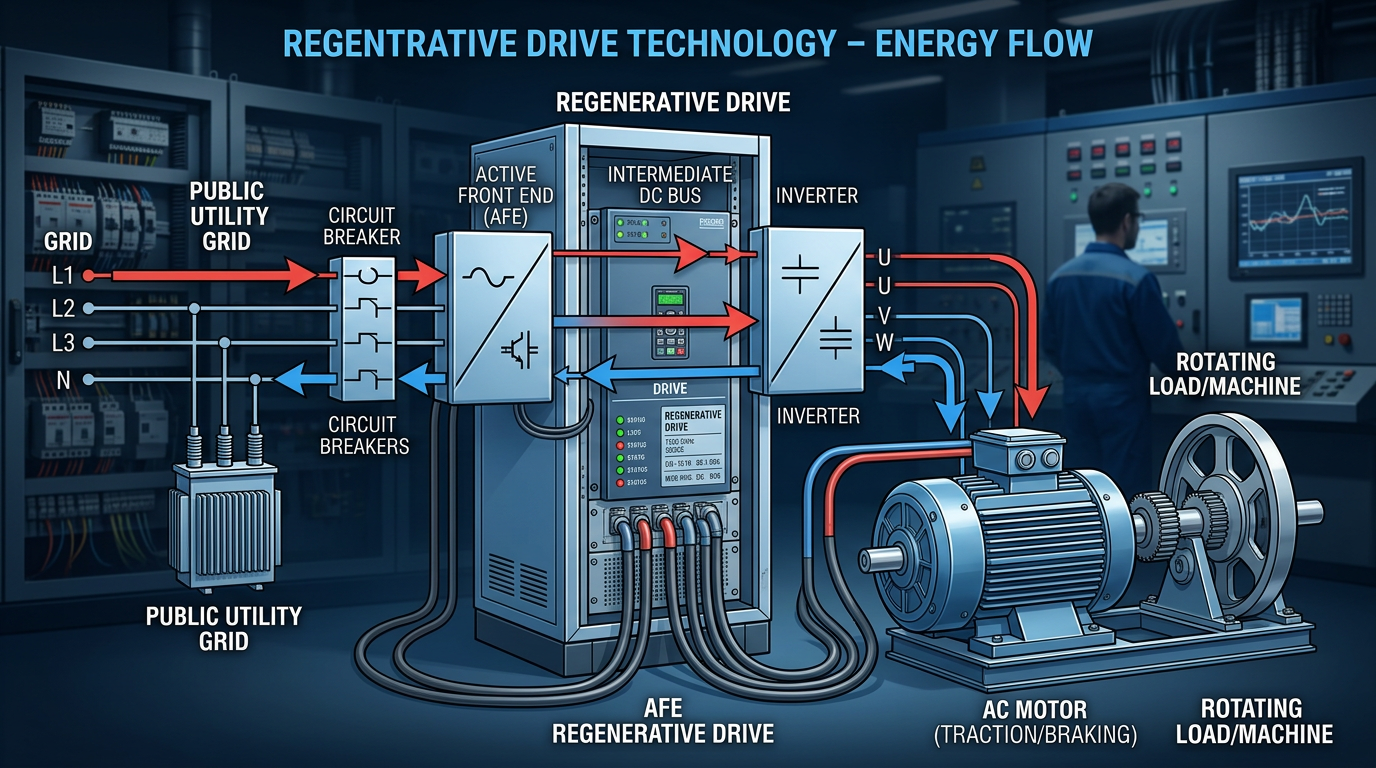
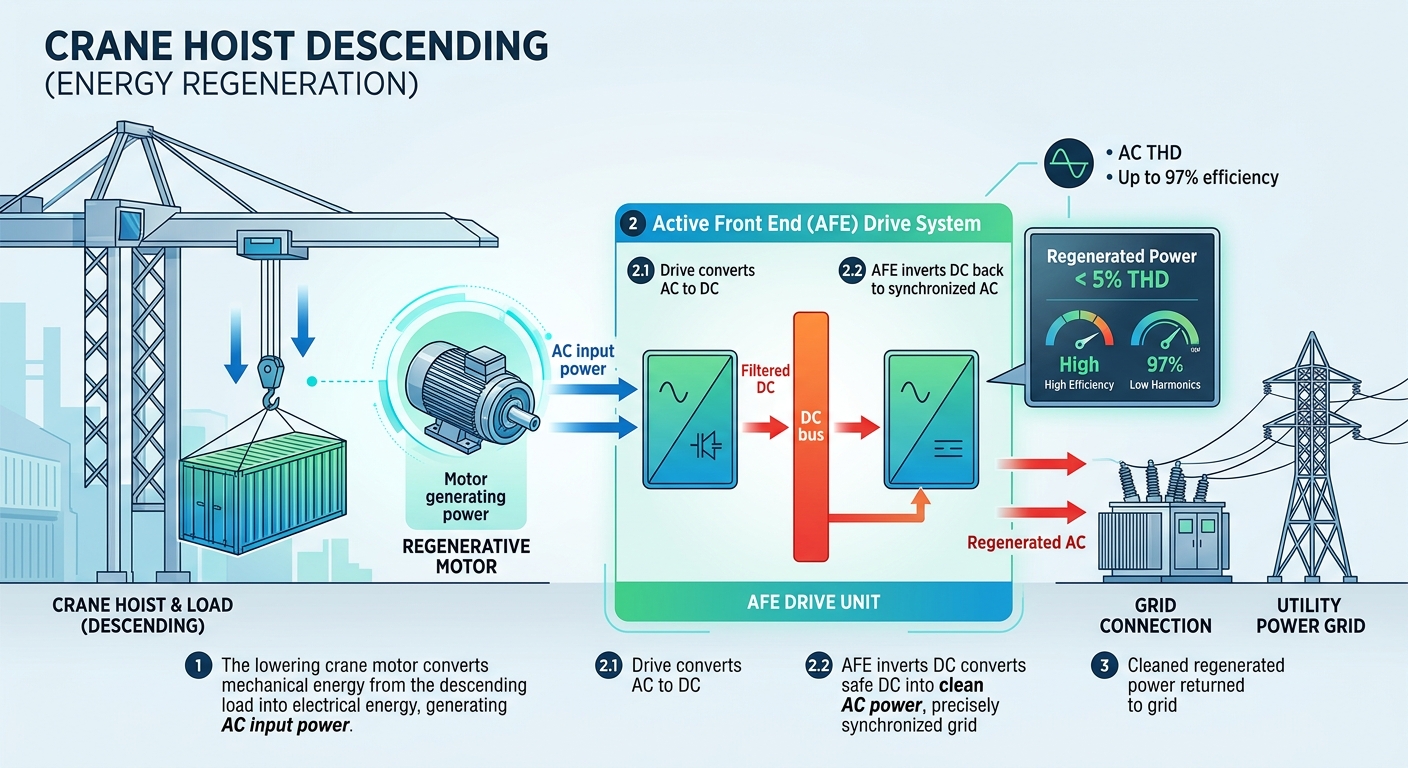
At its core, a regenerative drive handles energy differently than a conventional variable frequency drive. When a motor decelerates or is overhauled by a load (e.g., a descending crane hook), it becomes a generator. The kinetic energy is converted into electrical energy that flows back into the drive’s DC bus.
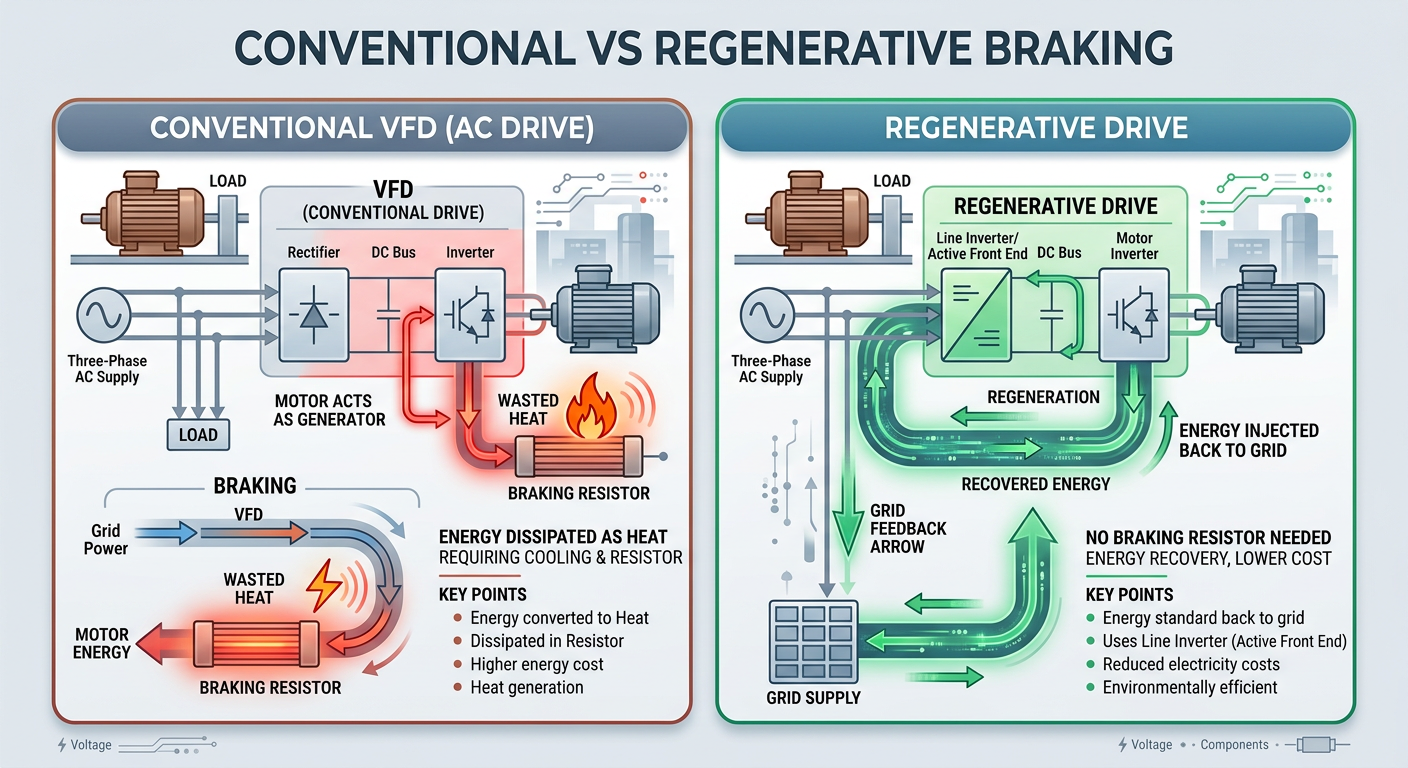
Conventional vs. Regenerative Braking
In a standard VFD, this excess energy is dissipated as heat across a braking resistor. That is wasted energy — and heat that must be managed with additional cooling. A regenerative drive, on the other hand, uses an active front end (AFE) or a dedicated regenerative unit to feed that energy back to the AC mains.
| Feature | Conventional VFD | Regenerative Drive |
|---|---|---|
| Energy recovery | None (dissipated as heat) | Up to 97% efficiency back to grid |
| Braking resistor | Required | Often eliminated or downsized |
| Harmonic distortion | Typically >30% THD | <5% THD with AFE |
| Heat generation | High | Low |
The key components include an IGBT-based rectifier (instead of a diode bridge) and a sophisticated control algorithm that synchronizes the regenerated power with the utility frequency and phase.
Key Applications in Indian Industries
Regenerative drive technology shines in applications where the load frequently operates in the braking quadrant — that is, where the motor is driven by the load rather than driving it.
1. Cranes and Hoists
In overhead cranes, the load often requires controlled descent. Regenerative drives capture that gravitational potential energy. For port cranes or EOT cranes in steel plants, energy savings can exceed 30% of total consumption.
2. Elevators and Escalators
Modern high-rise buildings in Indian metros can recover significant energy from elevator movements. A regenerative drive can feed power back to the building’s electrical network, reducing the net draw from the grid.
3. Centrifuges and Extractors
Industries like sugar, pharmaceuticals, and textiles use heavy centrifuges. During deceleration, regenerative drives convert rotational inertia into usable electricity.
4. Downhill Conveyors
In mining and material handling, conveyor belts moving downhill produce continuous regenerative power. This can offset the power consumed by other equipment on the same line.
“We have seen clients in cement plants cut their motor energy bills by up to 25% by switching to regenerative drives on downhill conveyors.” — Digital Controls application engineer.
Benefits Beyond Energy Savings
While recovering energy is the headline benefit, regenerative drive technology delivers several other advantages that matter on the plant floor.
Reduced Heat and Cooling Costs
Without braking resistors dumping heat into the control panel, enclosure temperatures drop significantly. This means smaller or no forced ventilation, longer component life, and lower air-conditioning loads in nearby control rooms.
Lower Total Harmonic Distortion (THD)
Active front end regenerative drives typically produce THD below 5%, easily meeting IEEE 519 guidelines. This is critical when sensitive equipment like PLCs or medical devices share the same bus. For more details on drive families with low harmonic performance, see our Ach 580 Ultra Low Harmonic Drives page.
Improved Grid Stability
Because regenerative drives can both absorb and deliver reactive power, they can help correct power factor without additional capacitor banks. Many utilities in India offer incentives for power factor improvement.
Extended Mechanical Life
Smoother deceleration and elimination of resistor bank switching stress reduce wear on motors, couplings, and gearboxes.
ABB’s Regenerative Drive Solutions
ABB offers several drive series that support regenerative operation. The most versatile is the ABB ACS880 family, available from 0.55 kW to 6 MW. It can be configured with an integrated regenerative front end or connected to an external regenerative unit like the ABB R8i.
ACS880 with Regenerative Front End
- Power range: 2.2 kW to 5600 kW
- Supply voltage: 380-690 V
- Built-in DC link with optional brake chopper
- Supports common DC bus configurations for multi-drive systems
ACS580 – General Purpose with Regenerative Option
For simpler applications where full regenerative performance is needed, the ACS580 can be paired with an external regenerative brake unit. This is a cost-effective choice for standard-duty applications like fans and small conveyors that occasionally brake.
ABB Drive Selection Tools
Selecting the right regenerative drive has become easier with ABB’s web-based drive and motor selector. Instead of flipping through datasheets, you answer a guided questionnaire about your load profile (constant vs. variable torque, duty cycle, braking energy). The tool recommends the exact model and even generates a bill of materials. This is a major time-saver for Indian engineering teams working on tight project timelines.
Selection Criteria for Indian Projects
When evaluating what is regenerative drive technology for your specific need, consider these factors:
1. Duty Cycle and Braking Frequency
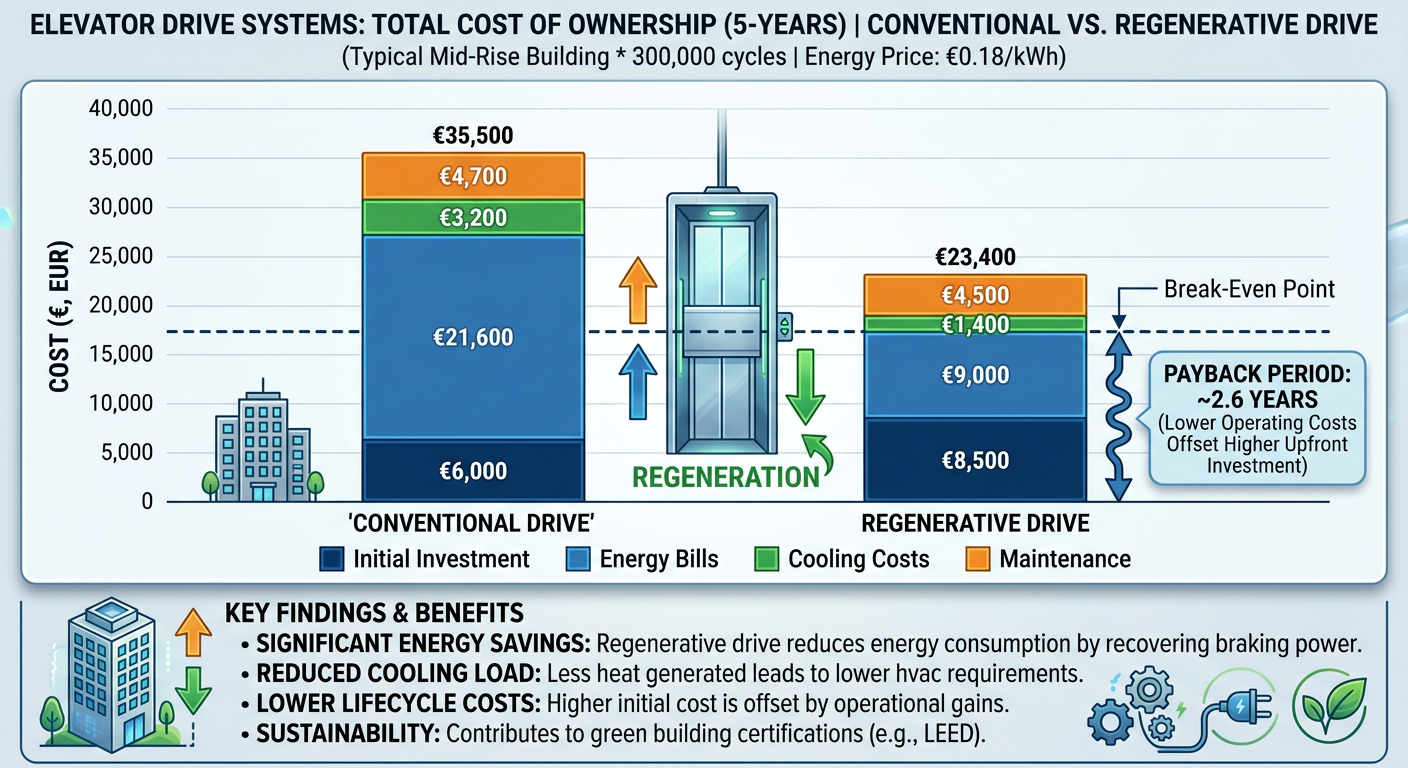
The higher the percentage of time the motor spends in braking mode, the faster the payback. For elevators that run 18 hours a day, payback can be under two years. For occasional braking (e.g., a centrifuge used once per shift), a standard VFD with a resistor bank may still be more economical.
2. Grid Compatibility
Regenerative drives feed power back into the grid. In India, the quality of the utility supply, especially in rural industrial areas, can vary. ABB drives include robust line filters and phase-loss protection to cope with weak grids.
3. Total Cost of Ownership
Don’t just compare the upfront price. Factor in:
- Savings from eliminated braking resistors
- Reduced cooling system costs
- Possible power factor penalty avoidance
- Maintenance savings from lower thermal stress
4. Application Categories
Remember the distinction between constant torque (heavy duty) and variable torque (normal duty). For a hoist or crane (constant torque), you need a drive sized at least 100% continuous overload rating. ABB’s ACS880 series offers dedicated heavy-duty ratings. For more on selecting the right drive platform, visit our AC Drives page.
Frequently Asked Questions
Q1: What is the difference between regenerative and dynamic braking?
Dynamic braking dissipates energy as heat via a resistor, while regenerative braking returns it to the power supply for reuse. Regenerative is more efficient but requires an active front end or common DC bus.
Q2: Can regenerative drives work with existing motors?
Yes, as long as the motor is compatible with the drive’s voltage and frequency range. Standard induction motors work well. For maximum energy savings, pairing a regenerative drive with a synchronous reluctance motor (SynRM) from ABB can push system efficiency above IE5.
Q3: Are regenerative drives expensive?
The initial investment is higher (20-40% more than a standard VFD), but energy savings often recover the extra cost within 1-3 years, depending on the application. Many Indian projects qualify for government energy efficiency subsidies.
Q4: Do regenerative drives require special installation?
They require a compatible supply network (e.g., ability to accept power backflow). Most industrial grids in India are fine. However, for weak grids, adding a line reactor or isolation transformer is recommended. Our team provides application review and control panel coordination — explore our Services page for commissioning support.
Conclusion and Next Steps
What is regenerative drive technology? It is a proven method to capture braking energy, reduce heat waste, and improve overall system efficiency — especially in cranes, elevators, centrifuges, and downhill conveyors. For Indian engineers and plant managers aiming to lower energy costs and meet sustainability targets, regenerative drives from ABB offer a reliable, future-proof solution.
We recommend starting with an application-specific sizing review. Our technical team at Digital Controls can help you evaluate your load profile, select the right ABB drive (ACS880, ACS580, or with regenerative units), and integrate it into your control panel. Request a consultation via our Enquiry page or call us to discuss your next project.
Digital Controls — Your trusted partner for ABB drives, Fluke test instruments, and industrial automation solutions across India.