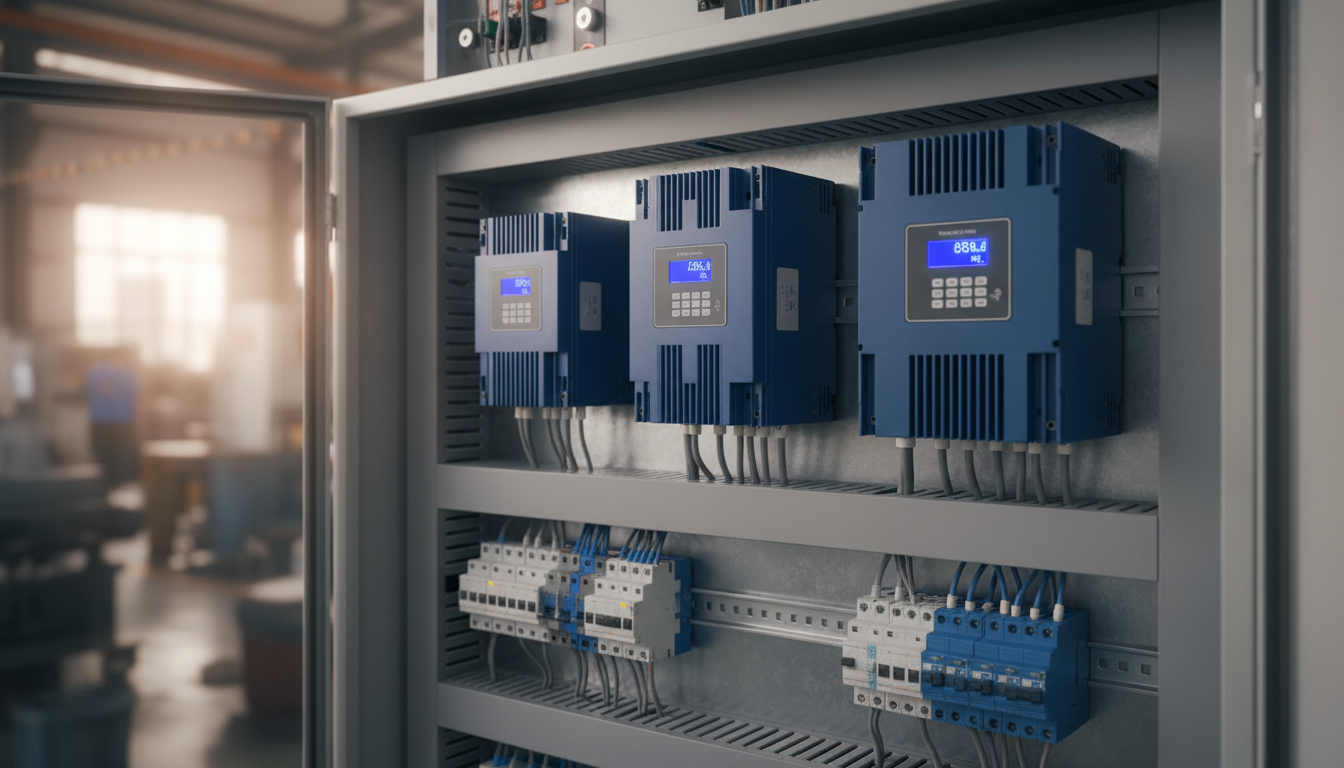
ABB AC Drive Selection Guide: How to Choose the Right ACS Series VFD
Compare ABB ACS180, ACS380, ACS480, ACS580 and ACS880 drives by power range, load type and features, with sizing tips and application picks for Indian plants.
If you're an engineer, plant manager, or procurement professional sourcing a variable frequency drive (VFD) for an industrial application, you've probably asked yourself: Which ABB AC drive is the right one for this job?
ABB's ACS series is one of the most widely deployed low-voltage AC drive families in the world — but with series spanning from 0.25 kW compact drives to multi-megawatt industrial drives, the selection process can feel overwhelming.
This guide breaks down each ABB ACS series, the criteria you need to evaluate before buying, and how to match the right model to your application — whether you're running a centrifugal pump in a water treatment plant or a crane in a steel mill.
Understanding ABB's ACS Drive Family
ABB organises its low-voltage AC drives into a clear hierarchy, each series designed for a distinct set of applications and power ranges. Here's the lineup at a glance:
| Series | Power Range | Positioning |
|---|---|---|
| ACS180 | 0.25 – 22 kW | Compact drive for simple machinery |
| ACS380 | 0.25 – 22 kW | Machinery drive for OEMs, with adaptive programming and encoder support |
| ACS480 | 0.75 – 250 kW | Compact general-purpose drive for pumps, fans and conveyors |
| ACS580 | 0.75 – 500 kW | All-compatible general-purpose drive with built-in EMC filter and swinging choke |
| ACS880 | 0.55 – 5,600 kW | Industrial drive for demanding applications, with regenerative and ultra-low harmonic variants |
Power ranges are for the standard wall-mounted and cabinet ranges; confirm the exact frame and rating for your voltage with our team or ABB's catalogue.
For HVAC applications, ABB also offers the ACH580, a variant of the ACS580 platform with HVAC-specific features such as built-in BACnet. It's covered on our ACH580 product page.
Key Selection Criteria for ABB AC Drives
Before you pick a specific ACS model, work through these five criteria. They'll narrow your options quickly and prevent costly mismatches.
1. Power Rating and Motor Compatibility
The drive's kW rating should match or exceed your motor's nameplate rating. But don't stop there:
- Supply voltage: ABB ACS drives are available for single-phase 230 V supplies (small ratings) and three-phase 230 V, 400–480 V and 690 V supplies. Most Indian industrial installations run on 415 V three-phase.
- Motor current (FLA): The drive's rated output current must be at least the motor's full-load current. This matters more than the kW number alone.
- Overload duty: Does your application need light-duty overload (typically 110% for 1 minute, for pumps and fans) or heavy-duty overload (typically 150% for 1 minute, for conveyors and crushers)?
2. Application Type and Load Profile
Different loads demand different drive capabilities. We covered this in detail in our constant torque vs variable torque guide, but here's the quick version:
- Variable torque (centrifugal pumps, fans, centrifugal compressors): Torque rises with the square of speed. The ACS480 or ACS580 handle these easily on their light-duty rating.
- Constant torque (conveyors, extruders, positive-displacement pumps): Torque stays roughly constant across the speed range. Size on the heavy-duty rating — ACS580 or ACS880.
- High starting torque (cranes, hoists, mixers): These need high torque from standstill and precise torque control. The ACS880 with direct torque control (DTC) is the usual choice.
3. Environmental Conditions
Where is the drive going to live?
- Ambient temperature: Drives are rated for full output up to a specified ambient (typically 40 °C), with derating above that. Many Indian plants run hotter than this in summer, so check the derating curve or plan panel cooling.
- Dust, moisture, and corrosive atmospheres: IP20/IP21 drives are meant to sit inside a control panel or clean electrical room. For dusty or wet areas, choose an IP55 variant (ACS580 and ACS880 offer them) or install the drive in a sealed panel. In humid or coastal sites, also plan for panel humidity control.
- Altitude: Above 1,000 m, drives need derating (typically 1% per 100 m).
4. Communication and Integration Needs
Modern plants run on automation networks. ABB ACS drives support:
- Modbus RTU (built into most ACS series)
- PROFIBUS, PROFINET, EtherNet/IP, EtherCAT and others (via plug-in fieldbus adapter modules)
- BACnet (built into the ACH580 for building automation)
If you're integrating with ABB PLCs, see our guide to integrating ABB PLCs with existing control systems.
5. Harmonic Mitigation and EMC Compliance
- ACS580 includes a built-in swinging choke that reduces harmonic distortion, often removing the need for an external line reactor.
- ACS880 is available in ultra-low harmonic variants with an active front end, which keep current harmonic distortion very low at the drive's terminals.
- For drives without a built-in choke (ACS180, ACS380, and the smaller ACS480 frames), you may need external line reactors or harmonic filters depending on your installation and IEEE 519 requirements.
ABB ACS Series: Detailed Comparison
ACS180 — The Compact Workhorse
Best for: Small pumps, fans, conveyors, and simple machinery.
- Power: 0.25–22 kW; single-phase 230 V input for small ratings, three-phase for the rest
- Key features: Built-in Modbus RTU, Safe Torque Off (STO), compact design, coated boards
- IP rating: IP20 (panel mounting)
- Why choose it: If you need a reliable, no-frills drive for a small motor with ABB quality at an entry-level price point, the ACS180 fits. It's also quick to commission.
ACS380 — Machinery-Specific Precision
Best for: OEM machinery, material handling, food & beverage equipment, textile machines.
- Power: 0.25–22 kW
- Key features: Built-in STO, adaptive programming, encoder feedback support, compact design
- IP rating: IP20
- Why choose it: The ACS380 is purpose-built for machine builders. Adaptive programming lets you add simple machine logic in the drive itself, and encoder support gives tighter speed control for indexing conveyors, winders and packaging lines.
ACS480 — Compact General-Purpose Drive
Best for: Pumps, fans, compressors and conveyors in process and utility applications.
- Power: 0.75–250 kW
- Key features: Built-in Modbus RTU, PID control, pump and fan application macros, energy efficiency calculators
- IP rating: IP20 (panel mounting)
- Why choose it: The ACS480 covers most everyday pump and fan duties in a compact, panel-mounted format. If you're selecting a VFD for a pump application, it's often the right starting point.
ACS580 — The All-Rounder
Best for: General industrial applications where ease of use, harmonic performance and broad compatibility matter.
- Power: 0.75–500 kW
- Key features: Built-in swinging choke and EMC filter, primary settings menu for quick setup, energy efficiency calculators, optional Bluetooth control panel
- IP rating: IP21 (standard), IP55 (option)
- Why choose it: The ACS580 is ABB's most versatile general-purpose drive. The built-in choke reduces harmonics without external hardware, and the assistant control panel makes commissioning straightforward. It's the default recommendation for most general industrial applications. Read more on why the ACS580 is ABB's go-to general purpose drive.
ACS880 — The Industrial Powerhouse
Best for: Heavy industry — cranes, extruders, winders, rolling mills, marine, mining, and any application that needs high dynamic performance or regenerative braking.
- Power: 0.55–5,600 kW
- Key features: Direct torque control (DTC), integrated safety functions, adaptive programming, regenerative and ultra-low harmonic variants
- IP rating: IP21 (standard), IP55 (option), plus cabinet-built drives
- Why choose it: When the application is critical and downtime isn't an option, the ACS880 is the answer. DTC gives precise speed and torque control, even without an encoder, and the regenerative variants return braking energy to the supply instead of burning it in resistors.
Application-Specific Drive Recommendations
A quick-reference table matching common industrial applications to the usual ACS series:
| Application | Recommended Series | Why |
|---|---|---|
| Centrifugal pump (≤22 kW) | ACS180 or ACS480 | Variable torque, simple PID control |
| Centrifugal pump (>22 kW) | ACS480 or ACS580 | Pump macros, harmonic performance |
| HVAC fan / cooling tower | ACH580 or ACS580 | BACnet (ACH580), built-in EMC filter |
| Belt conveyor | ACS380 or ACS580 | Constant torque, smooth ramps |
| Packaging machine | ACS380 | Machine logic, encoder feedback |
| Extruder / mixer | ACS880 | High starting torque, DTC precision |
| Crane / hoist | ACS880 | Heavy-duty overload, brake control, safety functions |
| Screw compressor | ACS580 | Constant torque, energy calculators |
| Textile machine | ACS380 | Compact, encoder feedback, precise speed |
| Water treatment plant | ACS480 or ACS580 | Multi-pump PID control |
How to Size Your ABB Drive Correctly
Sizing errors are one of the most common causes of nuisance trips and premature drive failure. Follow this checklist:
- Start with the motor nameplate: Record kW, voltage, full-load current (FLA), and service factor.
- Identify the load type: Variable torque or constant torque? This decides whether you size on the light-duty or heavy-duty rating.
- Check the environment: Temperature, altitude, dust and humidity all affect derating. ABB's DriveSize tool automates this calculation, or we can run the sizing for you.
- Add margin where it's needed: A modest margin helps if the load may grow, but don't oversize blindly — an oversized drive costs more and can protect the motor less precisely.
- Check supply harmonics: If your installation has several drives or sensitive equipment on the same supply, plan harmonic mitigation — either the ACS580's built-in choke or external filters.
Common sizing mistakes to avoid
- Selecting by kW alone. A 15 kW motor with a high service factor or lower efficiency can draw more current than a 15 kW drive's continuous rating. Always match current, not just power.
- Using the light-duty rating for a constant-torque load. A conveyor or crusher sized on the light-duty rating will trip on overload at start-up or under jams.
- Ignoring long motor cables. Long cable runs (common with submersible pumps) can need output du/dt filters or sine filters. Check the drive's maximum cable length.
For the financial case for upgrading existing fixed-speed motors, see our energy efficiency and drive retrofit ROI guide.
Why Buy from an Authorized ABB Channel Partner?
ABB drives are widely available, but not all suppliers are equal. Here's what you get when you buy through an authorized channel partner like Digital Controls, with more than 30 years in industrial automation:
- Genuine product with full warranty: Grey-market drives can ship with outdated firmware, missing accessories, or no valid warranty.
- Pre-sales selection support: Our engineers help you match the right drive to your application — not just the one in stock.
- Commissioning support: We coordinate commissioning so your drive is configured correctly from day one.
- After-sales service and spares: Access to genuine spare parts and repair support.
- GST billing and pan-India delivery: Proper invoicing and delivery across India.
Frequently Asked Questions
What's the difference between the ACS580 and ACS880? The ACS580 is a general-purpose drive optimised for ease of use, with a built-in choke and EMC filter. The ACS880 is an industrial drive with direct torque control (DTC), extensive safety functions, and regenerative and ultra-low harmonic variants. Choose the ACS580 for standard pumps, fans and conveyors; choose the ACS880 for cranes, extruders, winders and other demanding applications.
Can I run a three-phase motor from a single-phase supply with an ABB drive? Yes, for small motors. The ACS180 and ACS380 are available with single-phase 230 V input for small ratings, and output three-phase power to the motor. This is useful where only a single-phase supply is available.
How do I know if I need an external line reactor? If you're using a drive without a built-in choke (such as the ACS180 or ACS380) and your installation has several drives, a weak supply transformer, or strict harmonic limits, an external line reactor is usually recommended. The ACS580's built-in swinging choke often removes this need.
What IP rating do I need? IP20/IP21 is standard for drives installed inside a control panel or clean electrical room. If the drive will be wall-mounted in a dusty or wet area, choose an IP55 variant. For outdoor installations, put the drive in a weatherproof panel with humidity control.
How much does an ABB VFD cost in India? Prices depend on the series, power rating, options and order quantity, so the best way to get an accurate price is to request a quote with your motor details and application.
Next Steps: Get the Right ABB Drive for Your Application
Selecting the right AC drive affects your plant's reliability, energy consumption and maintenance costs for years. Don't leave it to guesswork.
- Browse our ABB VFD range — available series, power ratings and specifications.
- Talk to an engineer — contact us with your motor nameplate details and application, and we'll recommend the right drive.
- Request a quote — genuine ABB drives with full warranty and pan-India delivery.
Digital Controls is an authorized ABB channel partner serving industrial buyers across India. Whether you need one drive or a plant-wide retrofit, we're here to help.
Last updated: November 2026. Product specifications are subject to change. Always confirm with the latest ABB technical catalogue or consult our engineering team for application-specific guidance.