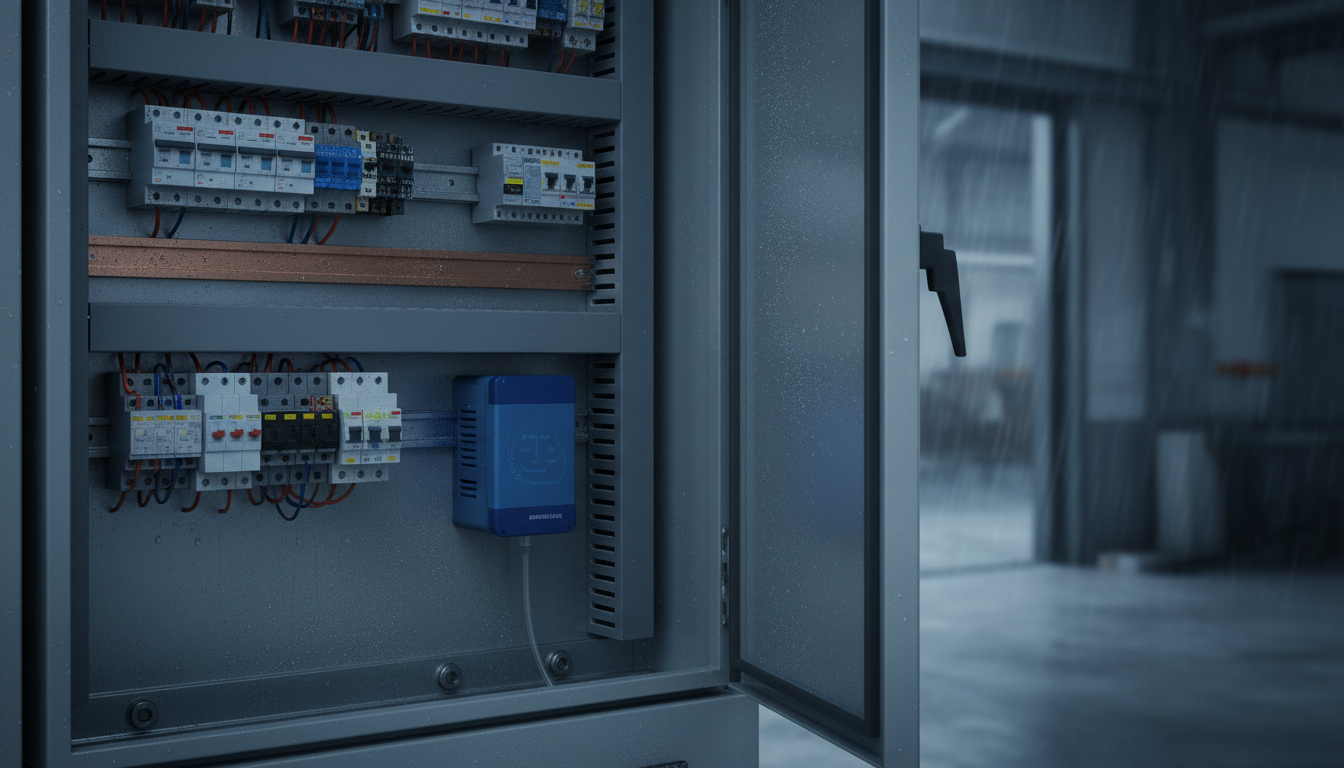
How to Control Humidity in an Electrical Panel: Condensation & Dehumidifier Guide
Why condensation forms in electrical panels, how Peltier dehumidifiers compare to space heaters, and how to size, mount and monitor a panel dehumidifier.
To control humidity in an electrical panel, keep the internal relative humidity (RH) between 40% and 50% and keep the enclosure's inside surfaces above the dew point of the air in the panel. Anti-condensation space heaters only warm the air — the water vapour stays inside the cabinet. For humid, coastal or outdoor sites, the most reliable approach combines good sealing of cable entries and doors with an active Peltier (semiconductor) panel dehumidifier that condenses moisture and drains the water outside the enclosure.
For plant engineers, maintenance managers and panel builders working across India's coastal, monsoon-prone and high-ambient industrial zones, moisture inside Motor Control Centres (MCCs), Power Control Centres (PCCs), PLC cabinets and VFD enclosures is a common cause of unplanned downtime. Below we cover why panel condensation happens, how active dehumidifiers compare to space heaters, how to size a dehumidifier for your enclosure, and how to verify panel health with diagnostic instruments.
Why Condensation Forms Inside Sealed Electrical Panels
A common misconception is that an IP65 or IP66 enclosure can't get moisture inside. In reality, IP ratings protect against water jets and dust, not water vapour or the pressure changes caused by heating and cooling.
Condensation inside an electrical cabinet is driven by three mechanisms:
- Dew point crossover during thermal cycling: During operation, components such as ABB ACS580/ACS880 VFDs, transformers, contactors and busbars heat the air inside the cabinet. Warm air holds much more water vapour than cold air. When the plant shuts down at night, or a monsoon downpour cools the sheet-metal walls, the enclosure skin temperature drops quickly. Once a wall or component surface falls below the dew point of the air inside, water condenses on it.
- Enclosure "breathing": As panel air heats and cools over a 24-hour cycle, it expands and contracts. On cooldown this draws humid outside air in through gaps in door gaskets, unsealed cable glands and conduit runs.
- Cable trench evaporation: Many MCC and PCC lineups sit directly over concrete cable trenches. Standing water or damp soil in the trench evaporates upward into the switchgear if the gland plates aren't sealed.
Dew Point Reference Table for Electrical Enclosures
Even when internal RH looks moderate during the day, a small overnight drop in sheet-metal temperature can trigger condensation:
| Internal Panel Air Temp | Relative Humidity (RH) | Dew Point | Condensation Trigger |
|---|---|---|---|
| 35°C | 50% RH | 23.0°C | Forms if a cabinet wall drops below 23.0°C |
| 35°C | 70% RH | 28.7°C | Forms if a cabinet wall drops below 28.7°C |
| 35°C | 85% RH | 32.1°C | Forms with just a 2.9°C drop in wall temperature |
| 40°C | 75% RH | 34.8°C | Forms if overnight ambient cools below 34.8°C |
| 30°C | 80% RH | 26.2°C | Common monsoon baseline in coastal plants |
The Cost of Panel Moisture: Corrosion, Tracking and VFD Trips
When moisture settles on energised components — especially combined with conductive dust — three failure modes accelerate:
- PCB corrosion and dendritic growth: Coatings on PLC I/O cards and VFD control boards are never perfect, and terminals are exposed. Moisture drives electrochemical migration between fine-pitch traces, causing intermittent communication drops, false readings and eventually board failure.
- Insulation breakdown and tracking: Moisture on phase barriers, terminal blocks and insulators creates leakage paths. Over time, carbonised tracks can lead to phase-to-earth or phase-to-phase faults — and to VFD overcurrent and earth-fault trips.
- Busbar and contactor oxidation: Copper and aluminium joints oxidise faster in humid cabinets, raising contact resistance. Higher resistance creates local hotspots (I²R losses) that degrade MCCBs and motor starters.

How to Control Humidity in an Electrical Panel: 5 Proven Methods
Controlling cabinet humidity takes a layered approach that deals with both moisture getting in and moisture already inside.
1. Active Semiconductor (Peltier) Panel Dehumidifiers — Best for Permanent Removal
An active dehumidifier for electrical panels uses the Peltier thermoelectric effect to pull water out of the enclosure air. A fan draws cabinet air across a cold plate held below the dew point. Moisture condenses on the plate, collects, and drains out of the cabinet through a drain tube.
- Why it wins: It lowers the actual amount of water in the panel air, without adding meaningful heat to temperature-sensitive VFDs and PLCs.
2. Anti-Condensation Space Heaters
Heaters controlled by a hygrostat or thermostat warm the internal air to lower its relative humidity and keep surfaces above the dew point.
- The limitation: Heaters never remove moisture; the water vapour stays in the enclosure. If power is interrupted during a shutdown, condensation forms as soon as the panel cools — and in hot weather, a heater adds load to panels that are already warm.
3. Cable Gland Sealing and Trench Barriers
Much of the humid air that gets into a panel enters from the bottom. Replace open knockouts and foam tape with IP-rated compression cable glands or modular cable transit frames, and seal cable trenches under the panel. Inspect door gaskets regularly for compression set.
4. Pressure-Compensation Breather Vents
In sealed outdoor cabinets (IP65/IP66), fit membrane breather vents (ePTFE). These equalise internal and external pressure during temperature swings — so the panel doesn't suck humid air past the gaskets — while keeping out liquid water and dust.
5. Desiccant Packs and Corrosion Inhibitors (Short-Term / Storage Only)
Silica gel bags and VCI (vapour corrosion inhibitor) emitters absorb small amounts of moisture during shipping, storage or before commissioning. In an operating plant, desiccants saturate within days to weeks and can release moisture back into the cabinet as it warms.
Comparison: Panel Humidity Control Methods
| Method | Removes Water from Panel? | Adds Heat to Panel? | Best Application | Key Limitation |
|---|---|---|---|---|
| Peltier panel dehumidifier | Yes (drains liquid out) | Minimal | MCCs, PCCs, VFD cabinets, outdoor kiosks, coastal plants | Needs a drain route out of the panel bottom |
| Anti-condensation heater | No (only lowers % RH) | Yes | Cold, dry climates | Fails during power-off cooldowns; adds heat in summer |
| Enclosure air conditioner | Yes (condensate drain) | No (actively cools) | High heat-load VFD and servo lineups | High cost and maintenance; can overcool at night |
| Fan and filter ventilation | No (circulates outside air) | No | Clean, dry indoor rooms with high heat loads | Pulls humid monsoon air and dust into the panel |
| Silica gel / desiccants | Temporarily (absorbs) | No | Transit, storage, small sealed junction boxes | Saturates quickly in operating plants |
Sizing and Selecting a Dehumidifier for Electrical Panels
Choosing the right panel dehumidifier depends on four things: enclosure internal volume (m³), how harsh the site is, available mounting space, and whether you need remote monitoring.
Step-by-Step Enclosure Volume Calculation
- Measure the internal height × width × depth of the enclosure section, in metres.
- Example: A typical MCC or VFD panel of 2.0 m (H) × 0.8 m (W) × 0.6 m (D) has a gross volume of 0.96 m³.
- Allow extra capacity (roughly 1.3× to 1.5×) if the panel is outdoors, in a coastal salt-air zone, in a washdown food or pharma plant, or above an unsealed cable trench.
- For multi-bay PCC or MCC lineups without solid partitions, spread dehumidifiers along the lineup rather than relying on a single large unit, so every bay gets dried air.
DryGuard Panel Dehumidifier Range
Digital Controls supplies the DryGuard range of semiconductor panel dehumidifiers, sized by enclosure volume:
| Model | Part Number | Power | Dehumidification Capacity | Enclosure Volume | Notes |
|---|---|---|---|---|---|
| DryGuard 15 | CZCS880 | 15 W | — | Up to 0.5 m³ | Compact ABS unit for sealed PLC and control enclosures; DIN-rail mounting |
| DryGuard 60 | CZCS860 | 60 W | 400 ml/day | 0.5 – 1.0 m³ | DIN-rail unit for MCC and distribution cubicles |
| DryGuard 60 Pro | CSAU60 | ≤70 W | 500 ml/day | 1.0 – 2.0 m³ | Aluminium-alloy housing; -30°C to +55°C operating range; for PCCs and harsher sites |
| DryGuard 120 | CZCS1000AX | 120 W | 1,000 ml/day | 2.0 – 3.5 m³ | Wall-mounted unit for large or outdoor-exposed enclosures; -30°C to +55°C |
Every DryGuard model has RS485 output for humidity, temperature and fault status. The DryGuard 15 and 60 are rated for 5–50°C ambient; all models operate up to 99% RH.
4-Step Protocol: Installing, Verifying and Monitoring Panel Humidity
A dehumidifier works best when paired with good diagnostics and control integration. As an authorized channel partner for ABB automation products and Fluke test and measurement instruments, we recommend this four-stage workflow:
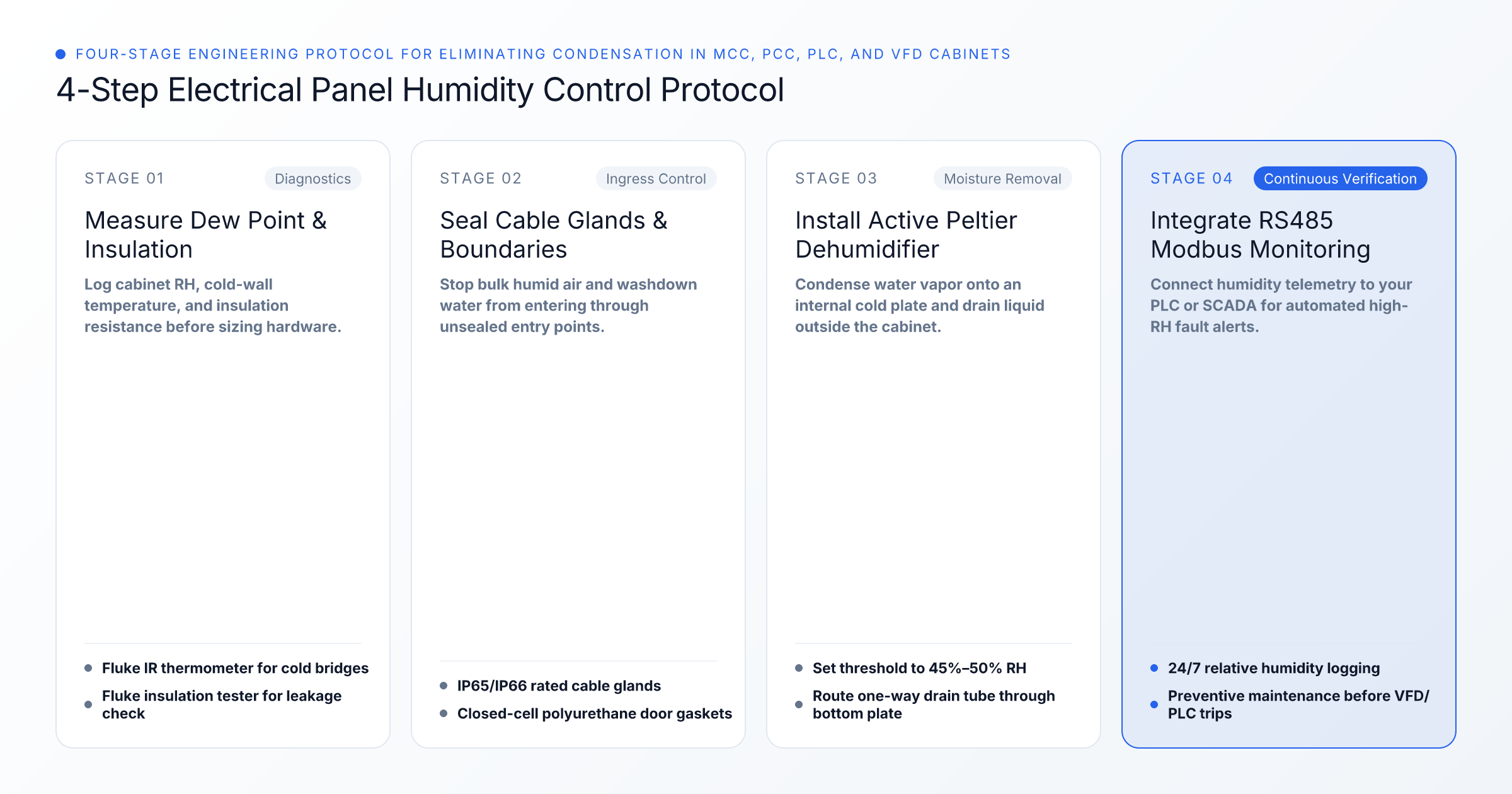
Step 1: Baseline Diagnostics with Fluke Instruments
Before modifying an existing panel or commissioning a new custom control panel, establish a baseline with Fluke diagnostic instruments:
- Cold-spot scanning: Use an infrared thermometer (such as the Fluke 62 MAX+) or a thermal imager in the early morning to find the coldest walls, roof plates and conduit entries where condensation forms first.
- Insulation resistance testing: If a panel has already seen high humidity, check insulation on motor feeders, busbars and cabling with a Fluke insulation tester before energising.
- Control power and leakage checks: Use a true-RMS clamp meter or multimeter (such as the Fluke 376 FC or Fluke 87V) to check auxiliary control power and look for leakage currents.
Step 2: Seal Entry Points and Mount the Dehumidifier
- Placement: Mount the dehumidifier in the lower-to-middle part of the cabinet — on 35 mm DIN rail for the DryGuard 15, 60 and 60 Pro, or screwed to the enclosure wall for the DryGuard 120 — with clear space around the air intake and outlet.
- Safety: Never mount the unit directly above exposed live busbars. Route the condensate drain tube continuously downward (no kinks or loops) through a sealed gland in the bottom plate, so the water leaves the cabinet.
Step 3: Set RH Thresholds
- Set the dehumidifier to start at around 50% RH and stop at around 40–45% RH.
- At 45% RH, the dew point of the panel air is roughly 12–14°C below the air temperature — enough headroom that ordinary overnight cooling of the walls won't cause condensation.
Step 4: Bring Telemetry into Your PLC or SCADA
- Wire the DryGuard's RS485 output into your ABB PLC or plant SCADA system to log cabinet temperature, relative humidity and dehumidifier status.
- Alarming on high RH lets maintenance act before moisture trips an ABB VFD or corrodes critical switchgear.
Frequently Asked Questions
What is the ideal humidity level inside an electrical panel?
For most industrial electrical panels, aim for 40% to 50% RH. Keeping RH below about 50% slows oxidation on copper busbars, limits moisture absorption in insulating materials, and gives a safe margin above the dew point so condensation doesn't form on cold walls.
Which is better for an electrical panel: a space heater or a dehumidifier?
In warm, humid, coastal or monsoon conditions, an active Peltier panel dehumidifier is usually the better choice because it condenses water vapour and drains it outside the cabinet. A space heater only lowers relative humidity while it's running — the water vapour stays inside and can condense once the heater or the plant switches off.
Where should a dehumidifier be mounted inside a control panel?
Mount it in the lower or middle section of the enclosure, away from heat sources such as VFD heatsinks or braking resistors, and never directly above exposed live busbars. Keep the air intake and outlet clear, and route the drain tube straight down through the bottom gland plate without upward loops.
Can condensation occur inside an IP65 or IP66 enclosure?
Yes. IP65 and IP66 ratings keep out water jets and dust, but they don't stop the air inside from cooling below its dew point during day-night temperature swings, or humid air being drawn in through cable glands as the cabinet "breathes".
Get Help Sizing Your Panel Humidity Control
Whether you're retrofitting MCC or PCC switchgear that trips during the monsoon or designing new VFD and PLC panels, controlling cabinet moisture is one of the most cost-effective reliability upgrades you can make.
Digital Controls has supplied industrial automation equipment for more than 30 years, including the DryGuard panel dehumidifier range, ABB drives, PLCs and low-voltage switchgear, and Fluke test instruments, across India.
- Specifications and quotes: DryGuard panel and cabinet dehumidifiers
- Need a moisture-protected panel built for you? Custom MCC, PCC, PLC and VFD control panels
- Equip your maintenance team: Fluke thermal, insulation and electrical test instruments